Showing posts with label Munhall High School. Show all posts

Saturday, October 9, 2021

World Series Game 7: "The Greatest Game Ever Played" October 13, 1960


            "Just to hit the ball an' touch 'em all, a moment in the sun
                It's a-gone and you can tell that one goodbye." 

                                                                    -John Fogerty "Centerfield"

For those who experienced them, some events are indelibly etched into our memories: the Kennedy assassination, the September 11th terrorist attacks. We remember exactly where we were and what we were doing when we heard they happened. For me, there's another event that's unforgettable, as it undoubtedly is to thousands of other Pittsburghers who witnessed it: Game 7 of the 1960 World Series.

During the late 1950s, I followed in the footsteps of my grandfather, George W. Busch, one of the Pirates' biggest fans in their first half-century. As I described in Darkness Visible, as a teenager, he played Pittsburgh sandlot baseball--which is where he met Honus Wagner. Dad told me about the time when Wagner came to dinner at the house on 21st Avenue. It was one of Dad's unforgettable moments.

                                                                 Honus Wagner

 Grandpap became a master machinist in the USSteel Homestead Workers; Wagner became one of baseball's greatest players. Grandpap always kept connected to baseball through his organizing and support of mill teams. He went to every Pirate opener (save one). In his father's later years, Dad would drive him to Oakland, park over by Carnegie Tech, and they'd walk the mile or more over to Forbes Field, Grandpap matching strides with Dad. The remaining season's games he'd listen to sitting in his chair by the console radio. More than once, I remember him waking, startled, after he dropped off to sleep during a dull inning. "I was just resting my eyes," he'd say.

One day in the mid-1950s, Dad noticed retired Pirate Hall of Famer, Pie Traynor, across the street from the Katilius store on 8th Ave, Homestead, promoting car sales at Toohey Ford. He took me over to meet Traynor. I was surprised that Traynor recognized him and inquired about Grandpap. It was then I realized that Grandpap had a lot of history with Pittsburgh baseball.

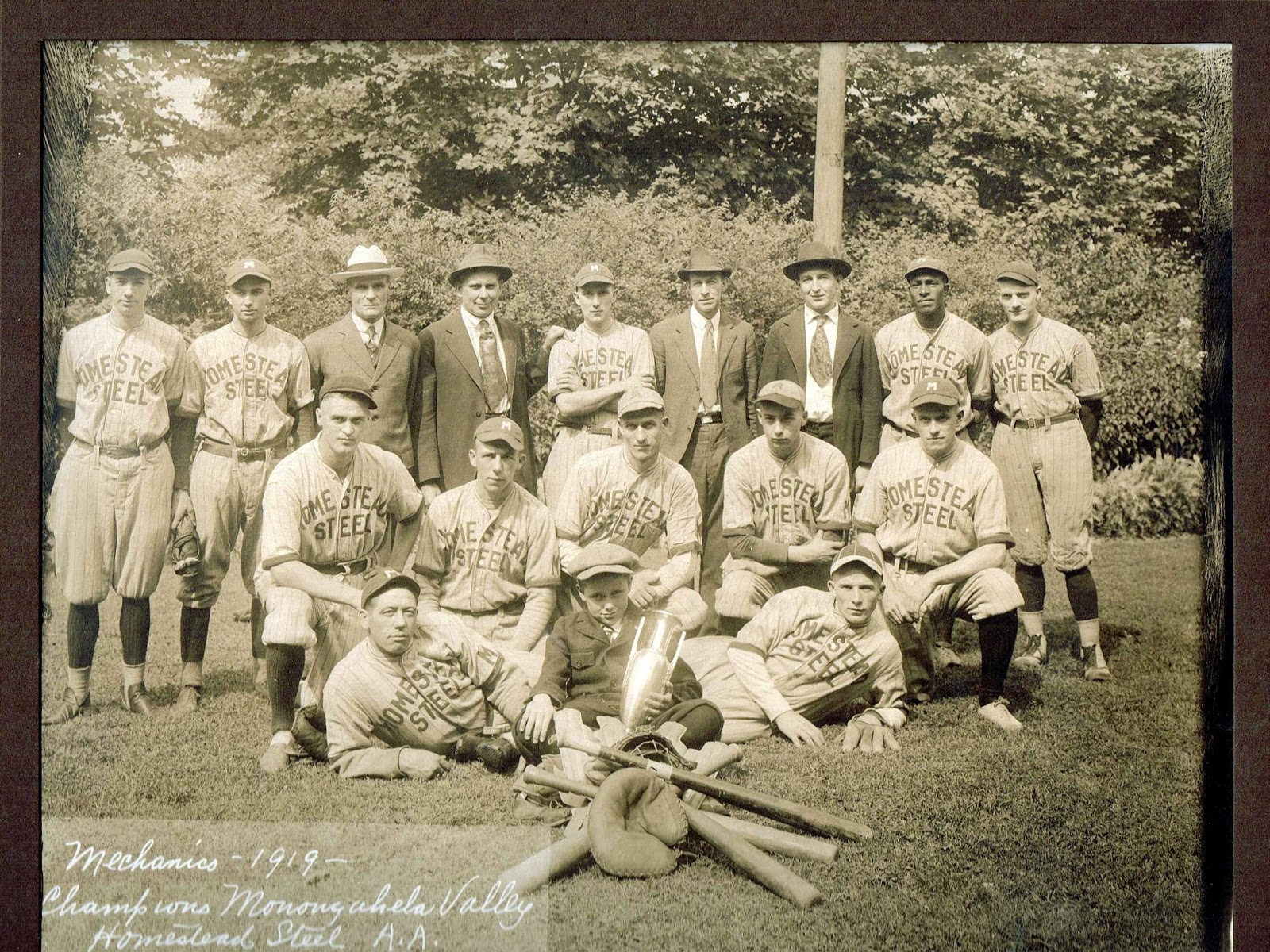
Dad was not as thrilled with baseball as his father. A photo of the US Steel 1919 Mechanics baseball team (a photo circulated locally during the '90s), shows Grandpap at left center and grumpy Dad as bat boy. Dad told me that he was miserable being bat boy, and he resented being dragged to these adult games.


I was not such a big Pirates fan as my grandfather, but during the years running up to the '60 World Series, I became devoted to the team. On May 29, 1959, I stayed up past 11 on a school night to listen to the play-by-play of what many have called "the greatest game ever pitched." Pirate pitcher Harvey Haddix pitched 12 2/3 no-hit innings against the Milwaukee Braves when a teammate's error allowed the Braves to score. The loss was heartbreaking, and I was dragging the next day at school. But it was worth it to live through that cliffhanger of a game.

                                                 Harvey Haddix on the pitcher's mound.

My dad would sometimes take me and couple of friends to Forbes Field, where we bought 99-cent tickets to watch the game from the bleachers. I definitely watched more games from there than from anywhere else in the stands. The view of the field was pretty good, and you could watch the pitchers warm up right in front of the section.

                                Left field, Forbes Field, 1920s, bleachers visible at top center.

The 1960 season was a dramatic and uncanny one for the Pirates. As the season progressed, the Pirates wracked up a number of unbelievable come-from-behind wins, for example, the second game of an Easter double-header at Forbes Field with the Cincinnati Reds. The Pirates were behind 5-0 in the bottom of the ninth. but rallied to win 6-5 with a pinch-hit three-run homer by Hal Smith and a two-run walk-off shot by Bob Skinner, who was down to his last strike.

 “We came from behind so many times that year that it was unbelievable,” backup catcher Bob Oldis said. “Somebody always got a big hit in the seventh or eighth inning, whether it was Groat, Skinner or (Roberto) Clemente. They knew what they had to do to win.” [as quoted in "Sixty Years Later" Trib Live, Oct. 10, 2020]

       I still have my program from the Series. A friend whose father had connections with the Pirates got me a ball signed by the 1960 team. Years later, my mother, not realizing its significance, threw it in the trash.
 

By the time the World Series started on October 5th, Pittsburghers, always passionate sports fans, were psyched up. Game One, Forbes Field: Pirates 6, Yankees 4. But the next day at Forbes Field, the Yankees totally creamed the Pirates,16-3. 

At Yankee Stadium on the 8th, the Yankees once again humiliated the Pirates, 10-0 , although the next day the Pirates came back with a 3-2 squeaker. In Game Five in Yankee Stadium, with Harvey Haddix on the mound, the Pirates beat the Yankees 10-5. Back in Pittsburgh on Wednesday, the Yankees once again shut out the Pirates, 12-0.

So by Game Seven, on Thursday, the 13th, Pirates fans were in a frenzy. It was do-or-die day. At Munhall High School, students, staff, and faculty were restlessly waiting for the game to start at 1 p.m. The high school principal, Homer Beggs (good baseball first name), realizing that little work would be done that afternoon, let out school after lunch. 

       Pittsburgh native shortstop Dick Groat, whose sister Elsie taught in the Munhall schools 

Some people listened to the game on radios; some started walking home. Someone got hold of a console TV and set it up on the stage in the school auditorium. It was ridiculous--this little screen in an auditorium designed for plays and choir concerts. But about fifty or so people crowded in the front center section to watch the game unfold.  Because my dad was a teacher who had to stick around until the official end of school, my friends Joyce, Barbara, and I, who rode home with him, joined the group at the back of the section.

     Meeting in Munhall High School Auditorium, 1950s--Photo courtesy Borough of Munhall 

The game was already underway by the time we started to watch. I really can't remember many of the specifics of those last innings. (Read a full account of the game here: The Greatest Game Ever Played.) What I do remember is losing hope when the damn Yankees in the top of the 8th inning scored two runs, pulling ahead by three, with only 6 outs to navigate. The Pirates, however, in true comeback form, managed to score five runs in the bottom of the 8th, moving ahead 9-7. The Yankees were not going to take that lying down. In the top of the 9th, they scored another two runs, tying the score.

The auditorium--and Forbes Field--was filled with electric anticipation when, in the bottom of the 9th, with the bases loaded, Pirates' second baseman Bill Mazeroski stepped up to the plate. One ball. No strikes. At 3:37 p.m. Mazeroski swung hard, and crack! the ball sailed out in a long, beautiful arc over the left field wall. As David Schoenfield comments, "It was a massive blast. Forbes Field was massive to left field -- 365 feet down the line and 435 feet to the flagpole in deep left-center field. As Berra turns around to chase the ball, you can see it fly over the 406 marker carved out in the ivy. Considering the 18-foot wall it flew over, Mazeroski's home run must have traveled 430 feet or so."[ESPN, Oct.10, 2010]

As leftfielder Yogi Berra and the other Yankees watched the ball go over the wall in stunned disbelief, Mazeroski ran the bases, crossing home plate. The Pirates had won 10-9.

On the field, the Pirates went crazy. In the stands, people cheered and danced with joy. In the Munhall auditorium, we stood up, jumped around, cheered, and hollered. We came outside into the sunshine of that beautiful October day and saw the kids in the school buses leaning out the windows, shouting and cheering, as they pulled away. 

People got into cars and drove into the city to celebrate. Others rode buses and streetcars. The party went on a long, long time. But although the celebration was large and boisterous, it never degenerated into the free-for-all destructive sprees that have marred more recent sports celebrations. 

Blue-collar Pittsburgh had beaten the haughty New York Yankees.

Forbes Field is gone; Munhall High School is gone. Many of the players who played that October afternoon are gone. But the game will be remembered as long as baseball is played.

                                                 Celebrating in downtown Pittsburgh

"Whoever wants to know the heart and mind of America had better learn baseball." - French-American Historian, Jacques Barzun

Video: Game Seven Highlights                                  

John Fogerty "Centerfield": A wonderful compilation of black-and-white footage of baseball in the years up to the 1970s, including a clip of Mazeroski, #9, sending the ball over the left field wall, and the fans and players going crazy after.

Thursday, June 18, 2015

On Father's Day: Remembering Ed, George, and Anthony

“I believe that what we become depends on what our fathers teach us at odd moments, when they aren't trying to teach us. We are formed by little scraps of wisdom.”
― Umberto Eco, Foucault's Pendulum

I like the idea that we learn by experiencing, watching, and listening. When Father's Day approaches, my thoughts always turn to my father, grandfathers, and great-grandfathers. They are gone, so I can't call them or spend time with them. This year, I'm celebrating Father's Day by remembering them and their stories. I have photos of five of the seven: Dad, Grandpa Busch, Grandpa Katilius and my dad's grandfathers.

The only one of his grandfathers that my father knew was his mother's father, John Edwards (1848-1920). Of the seven fathers, John was the only failure. When his wife died, John, a drunken blacksmith from North Wales, abandoned his two younger children to a Pittsburgh orphanage. By the time they became adults, he had moved to Maryland. When he came for visits to Homestead, he often became a big family embarrassment. My dad remembers the occasional call from saloons in Homestead, asking Grandpa Busch to come down and remove his blotto father-in-law from his perch on the bar, singing hymns in Welsh. Dad also remembered him pie-eyed, singing "Oh How I love Jesus" as they rode on the streetcar--a custom passed down to Dad, who did not need to be drunk to sing in public. "Oh, How I Love Jesus" by Alan Jackson "Oh, How I love Jesus" by Alan Jackson (sorry, no Welsh accent).
The only known photo of John Edwards, taken in Richmond, VA.
[Since this post was written, I have discovered more positive information about John. Read about it in this blog post: "John Edward vs. the Man". It includes a link to a video of me singing, "O! How I Love Jesus!" at John's gravesite. Alan Jackson has nothing to worry about.]

John Paul Busch, my dad's paternal grandfather, was the inspiration for Darkness Visible.  He had the most children--thirteen, of which eleven reached adulthood. (For more about him see the blog post, "150 Years: Retracing John Paul's Footsteps. " "150 Years: Retracing John Paul's Footsteps"
The original photo, taken in the 1880s, from which the chalk-tinted portrait of him that used to hang in my grandparents' house, was made. It now hangs in my back parlor. In the tinted one, his suit is black and the tie has no stripes.   

I have not found photos of either of my mother's grandfathers, Joseph Katilius (d. 1885) and Charles Shefsky (1855-1926).  Joseph was killed by Cossacks in Lithuania. My mother had vague memories of Charles, who died when she was 10. Charles left Lithuania with his wife and three children in 1897.

My mother's father, Anthony Katilius (1879-1958), left Lithuania in 1908, escaping the violence and turmoil that took place between warring factions during the rise of the Bolsheviks.  He was a man of few words, speaking English with an accent. He was calm and even-tempered, patient and detail-oriented, traits that made him a good watch- and violin-maker. He had his own ethnic dance orchestra during the 'Thirties, which he led with the violin.  I remember him playing the piano and violin in the living room of the hilltop house on his beloved retirement hobby farm. After the war he brought over a number of Lithuanian DPs, who lived in the old farmhouse on the property until they found work. Grandpa offered me $15--an enormous sum-- if I learned to play "Repasz Band March" on the piano.  He died before I could take up the bribe, but I'm sure he'd be happy to know I eventually learned to play both piano and (church) organ.  "Repasz Band March" played on a theater organ Repasz Band March played on a theater organ. (*Note: I found that "Repasz Band March" for piano is available on free download. I've printed out a copy and I'm working on it. I won't get the $15, but will still have the satisfaction that (60 years later) I'll have learned to play it.)
My favorite snapshot of Grandpa Katilius.
Grandpa (r) and a guy named George in front of the Katilius jewelry, music, and appliance store, 505 E. 8th Avenue, Homestead, where you could buy Vega-Martin guitars and handmade violins, c. 1940.
Grandpap and his dog Lucky on the Farm, with the McGeevers' Studebaker in the background. My main memory of that doghouse is getting stung by a wasp while I was climbing on it.
                 
My dad's father, George Washington Busch (1874-1959)--also a character in Darkness Visible--was a second-generation American, an avid baseball fan who went to every single Pirate opener until the year before he died.  He was fond of folksy sayings like "How's your liver?" and "See you on the pickle wagon." George played football and baseball; he was a great promoter of local baseball teams from the Homestead Grays to the mill teams. His job, superintendent of the machine shop in the USS Homestead Works, required grace under pressure and skill in making and repairing mill machinery. In retirement, he chose to spend most of his time in the summer months working in his backyard flower garden or in the large plot of vegetables around the corner. He didn't play an instrument, but loved to sing. In his younger days he sang second tenor in a barbershop quartet. He, Dad, Uncle Jack Breakwell (the Three Tenors) and I (the one alto) would sometimes sing around the piano for hours after Sunday dinner.
Grandpa Busch with Ernie Stevens (left) in the machine shop office. This photo hung in my grandparents' bedroom for as far back as I can remember.
Grandpa sitting by the piano in the Breakwells' house in Squirrel Hill.
Grandpa at work in the 1920s. There was nothing small about the mill machine shop.

Both my grandfathers outlived their wives. I think Grandpa Busch had the harder time of it afterwards, alone in the house on 21st Street. Even though he was the eldest, he outlived all his brothers and sisters. After Grandma Katilius died, Helen and her family moved in with Grandpa on the Farm, where many friends and family members came to visit.

If George Busch was macro, Anthony Katilius was micro. George worked on gigantic machines in huge mill buildings; Anthony worked on watches and violins.  George worked for a big corporation, while Anthony worked for himself. George had a dozen siblings; Anthony left most of his family behind in Lithuania. But they both loved working outdoors,  one in his garden, the other in his vineyard, and they both loved music.
Dad, me, and Anthony on the Farm, 1945.
My father Ed Busch (1907-1998) resembled his father physically, but had a very different temperament. Dad got into scrapes with his father because of the latter trying to get him involved in sports. Dad was a lot more emotional than Grandpa, and while he enjoyed sports, his real love was the theater.

He played high school football and baseball, and tennis at Pitt, but he would much rather be acting or directing. He played summer stock in Connecticut, worked at the Pittsburgh Playhouse and for Grace Price Productions, and eventually organized his own children's theater company. Occasionally, I performed in his productions. Like George he loved to sing--in choirs and solo. He often embarrassed me by singing as he walked down the street or through a store (the Edwards gene coming out).

This photo of the 1919 Mechanics team from the Homestead Works has appeared all over the Homestead area. My father, the bat boy, shows by his downcast expression how miserable he was at being pressed into service. Grandpa is fourth from left.
From the 1925 Munhisko year book.

But Dad's true life's work was teaching. He was a born teacher and really enjoyed working with kids. He took his love of theater and science to the classroom, and also directed school plays. During his teaching years, he would come home before my mother (who worked in the Katilius store) and make dinner, a task he preferred to cleaning up--which she did.
In the Munhall H.S. chemistry lab. Dad won the Bausch and Lomb and Keivin Burns awards for excellence in science teaching.

But I remember him most for his stories. I got him a mug that read "Keeper of the Family Tales", for that's what he was. He told stories about his family, his school days, his teaching, his numerous travels all over the globe--so many stories I couldn't begin to write them all down. In fact, without his stories, this blog post would be a lot shorter. and Darkness Visible never would have been written.

So here's to you, Dad--and Grandpas Busch and Katilius. Thanks so much for the wonderful memories.
Dad getting his car ready for their honeymoon trip a day before his wedding.