Tuesday, December 24, 2013

Christmas in the 1950s: God Rest Ye Merry

 One of my friends recently lamented that she couldn't get in the holiday spirit this year. The holiday seemed more like work than fun. Gone was the magic. I sympathize with her; I certainly don't feel the holiday excitement  of my youth, or even of a couple of decades ago.

Is this because we are grown up, jaded with years of experiences that induce the bah-humbug response? Probably. I don't much enjoy the holiday shopping ritual.  Fighting the crowds, sliding around on slick sidewalks and roads, dodging traffic, getting your credit card hacked at a big box store. . .All of this contributes to a Yuletide malaise. Macy's wants us to "Believe!" In what? The magic of mass marketing?

"Bah humbug!" Alistair Sim is brilliant as Scrooge in the 1951 film version of "A Christmas Carol."
Without yielding to a sentimental celebration of the Good Old Days, I would like to look back at more magical Christmases to find what made them so.  The most magical of course are the early childhood ones with visits from Santa.  In early December, my parents would take me to see the Real Santa, the one who worked at Horne's.  They explained that the other Santas, the ones at Kaufmann's and Gimbel's, were only assistants. Shaking with apprehension, I would tell Real Santa what I wanted, then anxiously count the days till the 25th.

The waiting on Christmas Eve was tortuous. Filled with a mixture of joy and dread, I'd wake up at dawn. In the cold house (Dad had to stoke the coal-fired furnace to get the heat going in the morning) I'd creep slowly down to the first floor, step by step, my breath hanging in the chilly air, to peek around the corner into the living room. When I saw that gifts were under the tree and my stocking was filled, I'd tiptoe back upstairs and jump back under the covers. Seeing the gifts and anticipating opening them was the magical moment, not the opening itself.
Christmas '49. I'm posing with the doll, but what I really liked was the miniature gas station (right).
Years later, as with most parents, I would participate vicariously in my children's excitement about Santa's impending visits.  This time we adults got to be the one who stayed up after the kids went to sleep, putting out the presents, taking the milk and cookie set out for Santa, leaving a note from him to them.  On at least two Eves, our daughter Ceridwen got so excited, she broke out in hives. When younger daughter Morwenna was  in the first grade, she told me that the other students had said that Santa wasn't a jolly old elf, but Dad. "Is it true?" she asked.  Having read child psychology articles that advised always telling the truth when asked point-blank about Santa, I replied, "Yes." Stopping short of plugging her ears and saying, "Lalala, I didn't hear that," she was clearly devastated. It was one of the decisions I most regretted as a parent. With one word, I took the magic out of Christmas for her.
Morwenna in happier days with Santa. No matter that he is in his 20s and has a fake beard.
 Although Santa is a major contributor to the spirit of the holiday, he is not the only one. Growing up in Homestead, I loved to see the holiday decorations and lights in the houses and on the street. To pick out a tree, my mother and I would take a half hour or more, examining one after the other in the brick Second Ward school yard until, shivering with cold, we found the perfect one. They were often pines, not the "real Christmas trees", the firs that my dad remembered from his childhood. Our tree, like most, was strung with the big colored lights (and later, bubble lights).  The three front windows each had red cellophane wreaths with an electric candle in the middle, and the spruces outside also had strings of lights.
It seemed that half the houses in Pittsburgh in the 'Fifties had these wreaths--They were so cool, daddy-o.

We had our family food traditions, most notably plum pudding.  This was made in huge quantities at St. John's Lutheran Church from my English Uncle Jack's family recipe and sold as a fund raiser. A half dozen church women, aided by my grandfather, who cracked the walnuts, labored all day, mixing the pudding and steaming it in gigantic cauldrons. Served with lemon or hard sauce, it was an exceptional once-a-year treat. 
My plum pudding is done after three hours of steaming. It embodies Christmas with the Busches.

Neither of my parents were bakers, so we relied on others for holiday treats.  My dad's favorite was fruit cake--rich, moist, and succulent. Mine was the so-called hunky cakes, those filled cold dough cookies that melt in your mouth.
Known in the vernacular as "hunky cakes", these labor-intensive cookies of Slovak derivation were a must at many Pittsburgh holiday celebrations.

Music in particular evokes special feelings of the holiday. I started to list my favorite Christmas pieces, but had to stop, realizing that I could go on for many pages.  We sang carols at school, church, in the car, at the piano, wherever. One December my Grandfather Katilius had a machine brought to the store to make sound recordings. I cut a record of "Hark! the herald angels sing"; it's somewhere in a box in my house.
Caroling with Ceridwen's family, Christmas Eve 2010.

There's a video in that box, too, of another Christmas performance: a kinescope recording of my dad's play "A Great Light" which aired live on WQED-TV, Pittsburgh, on Saturday, December 22, 1956. I played the innkeepers' daughter, a blind girl. I remember very little of the story, but vividly recall singing the Coventry Carol (Dad had no problem with anachronisms) in front of the camera, pretending I couldn't see it. I also recall going to church the next day, where some of the young children told me how glad they were I really wasn't blind.  I took it as a wonderful compliment.

With Belva Seitz in "A Great Light" on WQED-TV, Christmas 1956
Even if I have no other parties at my house each year, I always have a solstice celebration and carol sing. My Victorian house is the perfect venue for this event, and for it, I put up a tree and decorate it with dozens of old ornaments, including those I brought from my parents' house in Munhall, a drum I made out of milk bottle caps in the second grade, and a blown glass Liberty Bell, the sole survivor from my father's early 20th century Christmas trees.
Drum (left) and bell (right)
This Christmas Eve morning I was, as usual, listening to the broadcast by the King's College Choir from Cambridge, England.  When they started singing "Away in the Manger," I was hit sideways emotionally, and began to blubber.  Yes, they were tears of sadness--for all the Christmases past and gone--but also tears of happiness for the memories of those Christmases, and hope for Christmases future.
Listen to it here:
The lovely 2003 performance of "Away in the Manger" by the King's College Choir.

Singers in the King's College Choir, 1951
Merry Christmas to all, and to all a good night.

Monday, September 9, 2013

150 Years: Retracing John Paul's Footsteps

     This August I made my fifth visit to Weißenstadt, Upper Franconia, Bavaria, whence my Great-Grandfather Busch emigrated in 1863. Synchronistically, but not intentionally, my first visit was in 1963 on a trip engineered by my father to meet his German cousin (first, once removed), Max .  Again unintentionally, this year's visit marked the 150th anniversary of  the emigration of John Paul Busch, aka Johan Paulus Pösch, to the USA. 
     In Darkness Visible John Paul appears as Karl Bernhard (the surname of his paternal great-grandmother).  Karl and John Paul share similar backgrounds: born in Germany, emigrated during the American Civil War, served as firemen on a U.S. Navy vessel, died in an explosion caused by saboteurs in the Homestead Works in September, 1892.
Wedding portrait of John Paul Busch and Susanna Bohlander

        My host and guide in Weißenstadt was Max's daughter and my third cousin, Hanne Heuer, a native of the town.  Hanne attempted to school me in the Weißenstadt dialect, which is unique to the town. Hanne's mother Tilly, who grew up on a nearby farm, still does not know the nuances of the town dialect, even after living there for six decades. Tilly, however, speaks German with the regional Fichtelgebirge accent, which John Paul probably spoke.
     
      John Paul was the eldest child of Johan G.Pösch and Katherina Ruckdäschel. I considered using her surname as Karl's in the book, but decided that it would be too weird for anglophone readers. I have since found out via ancestry.com and Hanne that Weißenstadt over the years, including today, has been crawling with Ruckdäschels.

But I digress.
1. The Town Square.  The buildings surrounding this market square were standing in 1863, when John Paul left for America.  In 1823, much of Weißenstadt was destroyed by fire, so these buildings post-date that. The square is at the top of a steep hill, apparently for protection, and the town was built around it. 
2. Wunsiedler Strasse, top. This view is taken from the same spot as the previous photo, but to the right.  Wunsiedler is one of Weißenstadt's main business streets.  The Pösch Backerei, at #1, is the second building at left.  
 3. City Hall. Presumably, there are no rats in this Rathaus, only civil servants.


4. The Bakery. This spacious three-story building has been home to many generations of Pösches.The doors at left used to be the delivery entrance for horse-drawn vehicles. The Pösches didn't become bakers until after John Paul left town. JP was trained as a tanner, but also learned how to fire a boiler in the town brewery. l-r, Tilly, me, Hanne, her brother Werner, and his wife Petra.
5. Strawberry Cake.  Made by Tilly for my birthday.

6.. Wundsiedler Strasse from the bottom. It's quite a steep slope to the square at the top.
7. The lane to the Eger River.  The city hall is at left, the church off to the right.  This steep lane, which goes from the square to the river, must have been walked by John Paul many times.
8. The Town Brewery, built after the fire in 1823, rebuilt 1895. They got water from the Eger River, which runs by the brewery. Here John Paul learned how to fire boilers, a skill that brought him fortune and misfortune.  Towns in northern Europe used to have civic breweries, where townsfolk could make their own beer.  People, including children, frequently drank weak beer because of worries about diseases spread through water.
9. House on the Eger River, across from the old brewery. This house, once grand, is now vacant and falling into ruin.  According to Tilly, decades ago townswomen would haul laundry to the river in carts to wash it. However, sometimes the laundry would look dirtier when it came out of the river than when it went in.
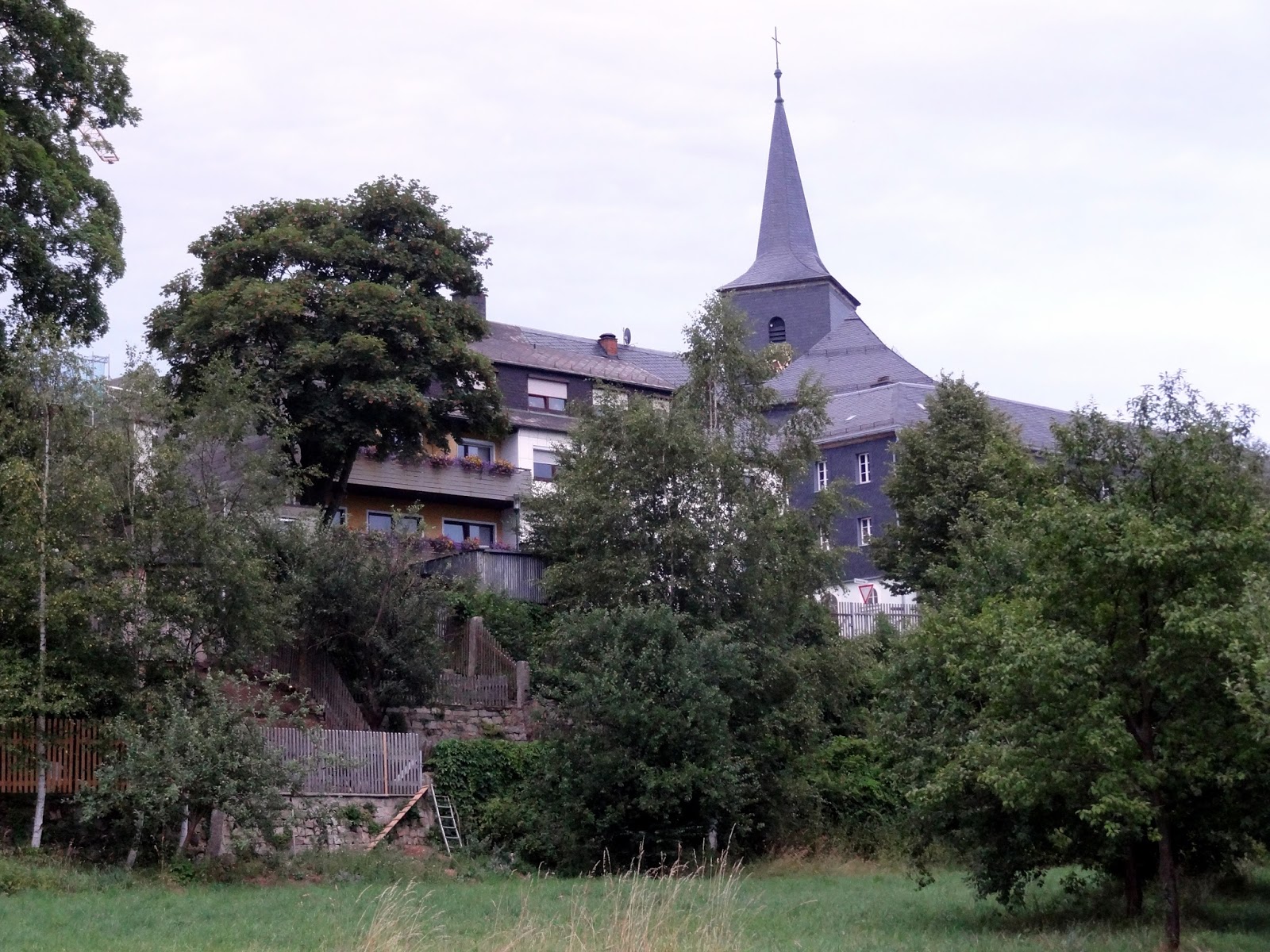
10. The steep hillside from the bridge over the Eger, spire of the church (Lutheran) at top.  The brewery is on the river below the bridge.
11. St. James Lutheran Church, interior.  John Paul was baptized and confirmed here, along with many other generations of Pösches.  The minister here gave Max a copy of the church records of the Pösch family, going back to Peter in 1529. The records previous to that were lost when the church was burned down during the Thirty Years' War.
12. The galleries and organ. I played this organ (Bach, what else?) in 1965.  Hanne said that when she was a child, as in John Paul's day, men and women sat on opposite sides of the sanctuary.
13. The church from the lake side of the hill.

14. Lake Weißenstadt panorama (Hanne and her husband Otto at right).  The original lake was expanded in the 1980s to shore up the region's faltering economic base.  Once an area known for porcelain factories and granite quarries, Upper Franconia fell on hard times.  The much larger lake is now a tourist center, with a huge campground, restaurants, and a fancy spa hotel on its shores. John Paul wouldn't recognize the lake today.
15. Pema bakery shop.  This commercial bakery in Weißenstadt produces heavy whole grain breads that are sold world-wide. To my amazement, my local food co-op, The Wedge, sells this bread. Small world.


16. 19th century houses.  In contrast to the house on the river, these lovely old houses are well maintained. They sit on one of the lanes behind the church.
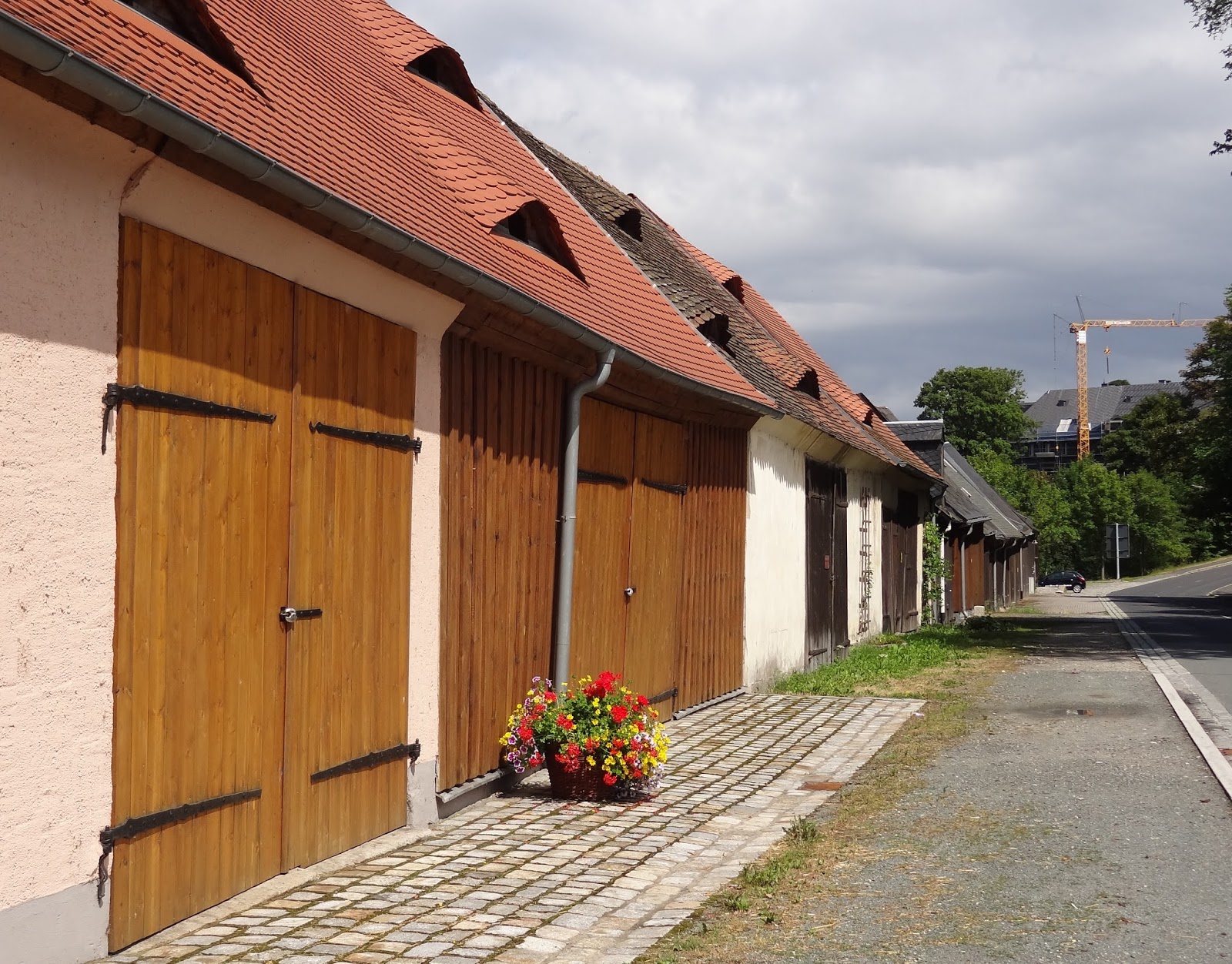
17. Garages. These structures on the road below the Eger bridge are now used as garages, but in John Paul's day they would have been wagon and equipment sheds.


18. Potato storage sheds. For many decades, townspeople stored potatoes and other root vegetables in these little structures on the outskirts of town. Tilly said that at the end of the war, the townswomen hid in these sheds, fearing what conquering soldiers might do.  However, when the Americans arrived, the woman were relieved to find they had nothing to fear.
19. The Lutheran cemetery (chapel in background).  Generations of Pösches are buried here, including Max and his parents.


20. Looking east. Beyond the mountains in the distance (Oxenkopf, Schneeberg) is the Czech Republic, only 15 miles away. Hanne thinks that the surname Pösch might have Czech origins.

--Photos by Trilby Busch


Monday, March 4, 2013

Inventing Traditions in the Old and New Worlds


      Darkness Visible contains stories of new "traditions" invented by immigrants as part of their assimilation into American culture.  Two of these involve that most traditional holiday, Christmas. Eirwen and Gwyn Jones have to decide if they are going to get a Christmas tree, a German-American custom, for their children.  Karl Bernhard, who can't afford to buy a real tree, makes one out of a broomstick.  However, it's not only these little traditions that sometimes need to be invented or reinvented.  Colonized nations also need to redefine themselves as unique cultures by using a reconstructed or invented past.


      In 1999 at a banquet celebrating St. David's Day, I gave a talk on "The Invention of Welsh Tradition" to the Minnesota St. David's Society. A large part of my talk was derived from historian Prys Morgan's scholarly article, "From a Death to a View: The Hunt for the Welsh Past in the Romantic Period."  I thought Morgan's account of the search for a new Welsh identity in the late 18th and early 19th century fascinating. For example, I was greatly amused by the shenanigans of Iolo Morganwg (born Edward Williams) in promoting his fabrication that the triple harp is a Welsh invention and in forging fake bardic poetry and documents to show that Welsh Prince Madoc did indeed make it to the New World.
Iolo Morganwg, "Eddie of Glamorgan" 1747-1826

      Some of the attendees were upset by my talk.  How could I undermine all their cherished beliefs about the "Land of Song" (another Romantic invention that Morgan takes on in the article)?  It's probably a good thing that I didn't give a talk to a Scottish group based on Hugh Trevor-Roper's "The Invention of Tradition: The Highland Tradition of Scotland," wherein he traces the development of the kilt and tartan "traditions." I might have been,  in "Monty Python" nomenclature,"slit up a treat."
    
An old postcard of the memorial to Prince Madoc in Mobile, AL, the site of his alleged arrival in North America.
       Recently I ran into some people from South Dakota who were completely committed to the belief that Prince Madoc came to America via Mobile and made his way up the Mississippi to come in contact with the Mandan tribe in South Dakota in 1171, scholarship to the contrary be damned.  I prudently was not drawn into a debate with them.  As T.S. Eliot famously wrote, "Humankind cannot bear too much reality."  But I am not surprised at the heated resistance encountered by historians and folklorists on this issue.  In response to the resistors, I point to the authority of Prys Morgan himself--author, retired history professor, president of the National Eisteddfod of Wales at Swansea, president of the Honourable Society of Cymmrodorion, joint director of the Iolo Morganwg project at the Centre for Welsh and Celtic Studies, and a Founding Fellow of the Learned Society of Wales.  You can't get more Welsh than that.
     Inventing traditions has been only part of the reconstruction of a national identity in the former colonies of England in the British Isles, namely Ireland, Scotland, and Wales.  Twentieth-century Welsh nationalists successfully saved ir hen iaith (the old language), Welsh, from being obliterated by English, and have secured its place as a living modern language.
       At the turn of the last century, Irish nationalists took on the even bigger task of developing a modern Ireland through its literature.  Declan Kiberd, in his 1996 work, Inventing Ireland: The Literature of the Modern Nation, "offers a vivid account of the personalities and texts, English and Irish alike, that reinvented the country after centuries of colonialism. The result is a major literary history of modern Ireland, combining detailed and daring interpretations of literary masterpieces with assessments of the wider role of language, sport, clothing, politics, and philosophy in the Irish revival" (Goodreads).
Prince Madoc saw flying saucers in South Dakota! (Just kidding)

      But there's also a disturbing aspect to these "inventions." From Queen Elizabeth I, who used the Madoc story to undermine Spain's claims in the New World, through the 19th Century, the British had a vested interest in the legend, which first appeared in a 15th-century poem.  It's unfortunate that the true believers of these "histories" often unintentionally treat other cultures as the colonial powers treated the native peoples they colonized--as inferiors.  An internet search of sites about the Madoc legend revealed that a number of them, including the BBC site, hail Madoc as the "discoverer of America." Ask the original native peoples what they think about that claim.  It suggests that anything deemed worthwhile by European culture, from prehistoric stone forts in Alabama to the Mandans' use of boats resembling the coracle. were invented by people from the Old World.  In the 18th century early British explorers spread the story that the languages of the indigenous peoples of America are related to Welsh, the legacy of Prince Madoc.  According to the invaders, American Indians apparently have little they can call their own.
      But the adherents to the Madoc story can provide no documented proof for their claims, except perhaps the forgeries of Iolo Morganwg. I accept the consensus view of scholars like Early American historian Samuel Eliot Morison, who contend that the Madoc legend is just that--a story that got traction after being used for centuries by various persons and groups (an English monarch, Welsh nationalists, British explorers, Welsh enthusiasts in the US) to further their agendas.

A verifiable, real "Prince Madoc", a research vessel of the University of Wales, Bangor, shown here in Belfast Lough.
       But I am not saying that these inventions are somehow bad or disreputable.  In fact, they have been an important part of the birth of the modern post-colonial nations of Scotland, Ireland, and Wales. Perhaps the biggest irony is that Iolo Morganwg used the Madoc legend to rebuild a national identity of Wales separate from that of the power that colonized Wales, England. It's a common misconception that myths are untruths, while actually they are potent metaphorical expressions of cultural identity.  As the Merriam-Webster online dictionary puts it, myths are stories of  "ostensibly historical events that serve to unfold part of the world view of a people or explain a practice." 
      My family has constructed several Welsh" traditions" that have no connection with the practices of my Welsh ancestors--the making of Welsh cakes for St. David's Day, for example.  I have also adopted other traditions from countries with which I have no ancestral connections, like the serving of Icelandic skyr around the Christmas holidays.  These traditions, whether old or new, familial or adopted, are what gives my family a sense of who we are and where we came from, that is, our identity as Americans.
      New Americans like Eirwen and Gwyn often have a difficult time deciding which is the more important part of their identity--the Old World or the New.  My Grandfather Katilius, an immigrant from Lithuania, wanted his children to learn the Lithuanian language, but my grandmother, who emigrated to America as a young child, was of a different mind.  She wanted her children to speak English only; she wanted them to be instantly identifiable as Americans. Soviet Russia intervened as well to block communication between my grandfather and his relatives back in the Old Country.  My grandmother's wish was granted.  If an American said to my mother, "I'm German," or "I'm Slovak," (meaning their ethnicity) my mother would proudly reply, "I'm an American."
      If you want to believe that Prince Madoc made it to South Dakota or that the Vikings erected a runestone in Kensington, Minnesota, go right ahead.  Drink green beer on St. Patrick's Day, do the Highland fling in a kilt.  Just don't try to convince me that these are derived from historical fact.  If you want to believe, just do it.
          
          King, beggar and fool, I have been all by turns,
          Knowing the body’s sweetness, the mind’s treason;
          Taliesin still, I show you a new world, risen,
          Stubborn with beauty, out of the heart’s need.

                                                                    --R.S. Thomas "Taliesin 1952"


The Church of St Hywyn. Aberdaron (built 1137). where R.S. Thomas served as vicar.

Friday, November 2, 2012

The Battle of Homestead--As seen on TV!

 "All great historical facts and personages occur, as it were, twice ... the first time as tragedy, the second time as farce."--Karl Marx


Hey, history buffs, swagger around like robber barons for three days. Enter the History Channel's giveaway for a chance to live it up in historic Las Vegas, the town built by more recent Men Who Built America, the Mafia.

On October 23rd, I belatedly tuned in to the History Channel's series on "The Men Who Built America: Bloody Battles," the episode about Andrew Carnegie, but only got to see the last 20 minutes.  On November 12th, I watched the whole two-hour passel of nonsense thrown together by some Hollywood screenwriter apparently on crack.

This episode is far, far worse than I had originally thought.  There are so many inaccuracies and outrages against Clio, the Muse of History, that I'll start with a just a few of them here:
1) The narrator, Campbell Scott, consistently mispronounces Carnegie's name as CAR-neg-ie, rather than Car-NEG-ie.  It's all the more glaring because he's the only one who does.
2) The actors who play Carnegie and Frick bear little resemblance to them. "Carnegie" is too tall and dark; "Frick" is too ugly--although I think this casting is intentional to make him look evil. H.C. himself would roll over in his grave if he could see how this terrible ham actor played him.
3) The interviews are mostly with modern-day robber barons, Donald Trump, for example.  For pity's sake!
4) Frick and Carnegie plan their skulduggery while walking around among workers in the mill.  One shot shows Frick personally delivering his ultimatum to a few workers.  Another shows him walking along in the mill, pushing workers aside with his shoulders.  So absurd!

The pre-battle background, according to the HC:

The narrator tells us that a small group of men were upset at being made to work longer hours, and eventually "reached the breaking point."  One guy is shown haranguing a couple of dozen workers about standing up to Frick.  Then we're told that when one worker was killed in the mill (image of guy covered in black makeup lying down, groaning), the men were spurred to strike.  The impression is that only one man had ever been killed, even though it happened frequently.

Now to the battle:

The battle starts when workers barricade themselves inside the mill.  We're told by a historian that the workers felt they owned the mill and were protecting their property.  Au contraire, Mr. Alleged Historian.  The workers were angry about low wages and long hours.  They had no desire to take over management of the company.  This is the mistake the anarchists, like Berkman, made.  They thought it would be easy to get the workers to unite and take over the company, when in fact the workers only wanted food on the table and housing for their families.

The images on the screen show men in black suits, wearing hats similar to officers' hats in the Civil War, approaching on foot the men standing behind the barricade.  Threats are exchanged (amazingly, in the words recorded in eyewitness accounts) and the MIB start shooting rifles at workers in clean, pressed shirts and pants.  Inside the derelict mill, the men in black are quite close to the other men, who, cowering behind pieces of metal, fight back with clubs and rocks. The MIB mow them down like flies. 

The first time I saw this, I was very confused.  Could this possibly be a dramatization of the Homestead Strike of 1892? To my amazement, it was.

Next they show a young MIB (aka Pinkerton), horrified at the slaughter, refusing to shoot at the strikers. An officer holds a gun to his head, and he aims and fires, dropping one of the strikers.  The "battle" continues.  The strikers throw rocks, but are no match for the rifle-toting MIB. One worker tries to help a wounded comrade, but is shot dead by the MIB.

And that's it.

WTF!?

The narrator goes on to say that the strikers eventually won the battle, but were crushed when the Pennsylvania Militia arrived.  He notes that nine strikers were killed, but says nothing about Pinkerton casualties.

This famous engraving from "Harper's Weekly" shows the defeated Pinkertons preparing to run the gauntlet. By then, they had been disarmed (not as shown). But the picture well illustrates the size and scope of the battle scene.

Here are some of the many, many inaccuracies:

*The Pinkertons were in barges on the river; the strikers were shooting at them from the high bank.  The Pinkertons were a good distance away from the strikers, many of whom had rifles.  In fact, it was the Pinkertons who were short of rifles.
*Even though the Pinkertons had the upper hand during the first hour of the battle, the strikers took control, shooting the barges full of holes and blowing off the cover of one.
*The Pinkertons officers were wearing their signature blue military uniforms.  Headgear as shown in contemporary illustration ranged from caps to bowlers.  On the sweltering barges,the Pinkertons fought in shirtsleeves. Many of the strikers, rousted from their beds in the middle of night, were disheveled, clad in nightshirts or anything they could grab at the time.
*Many of the actors playing the workers are overweight and out of shape.  They wouldn't have lasted a half hour in the mill.

But wait, that's not all.  As I sat there with my mouth open watching this travesty, the camera turns to a dramatization of Berkman's assassination attempt on Frick.  The scene is a dark room that looks like the study in a house.  Berkman walks down an empty hallway, comes into the room, asks, "Mr.Frick?" (Berkman isn't sure this is Frick. Really?) in an American accent, and shoots him once.  Frick, who is alone, immediately springs on Berkman, who stabs him in the gut.  Frick throttles Berkman, then beats him to a bloody pulp. The fight ends in the hallway, with Frick standing triumphantly over Berkman, who lies, battered and submissive, on the floor.  Several people run down the hallway to see what has happened. 

 This scene is just as ridiculous as the battle scene:
*Frick was working in his downtown office, not in a mansion.  His office was inside a larger office area where several people worked.
*Berkman, after waiting in the outer office for most of the day, burst in and shot at Frick (who was talking to an assistant) four times, hitting him once.  The assistant and another worker joined Frick in his struggle with Berkman, who pulled out a knife and stabbed Frick in the leg. The other men and Frick managed to subdue Berkman, but Frick definitely was the one who was the worse for the encounter.
*Berkman was from Russia and spoke English with a thick Russian accent.
This contemporary drawing shows Berkman bursting into the office as Frick is talking to his assistant

The History Channel obviously sympathizes with the strikers--too much so, as they take every opportunity to demonize Frick.

Is the History Channel's budget too small to afford a cast of thousands, literally, to reenact the battle?  I suspect that some digital wizards could easily and cheaply replicate the scene via computer.  A few still shots would certainly be preferable to the fantasies they showed. 

In 2006 PBS also dramatized the battle in their series, "Ten Days That Unexpectedly Changed America." Frankly, this version is even more ridiculous than the "Bloody Battles" version.  The scene shows a dozen men paddling a big canoe.  They beach it, as a dozen more men run at them over the flat shore of what looks like a lake.  OK, I exaggerate--about the canoe.  Nevertheless, I'm willing to cut PBS some slack for this low-budget silliness because this series sticks to the facts and doesn't try to snooker us with overblown rubbish. 

In the case of "Bloody Battles", I'd say that Marx's quote about historical events being experienced as tragedy and reproduced as farce applies. This episode calls into question all the other episodes they've produced.  How can we trust them to stick to the facts?  
"History is more or less bunk."
Henry Ford, Chicago Tribune, May 25, 1916

I'm not the only one who is worked up about the lack of facts in this series.  Tom Conroy of "Medialife" magazine titled his review 'The Men Who Made America. . .sort of:  History series plays fast and loose in these dumb-down sketches.'

History is, after all, the record of the past, not the past itself.  If the History Channel can't do better than this in checking the recorded facts, the channel should be renamed.  
I suggest borrowing from Henry Ford's famous declaration and call it The More Or Less Bunk  Channel--or simply The Bunk Channel. At  least we'd be forewarned.

Sunday, September 30, 2012

In the North Woods


        I am writing this at our cabin near the North Shore of Lake Superior, not far from the Canadian border.  Even though our cabin is fewer than four miles outside of the villiage of Grand Marais, Minnesota (pop. 1200) at the bottom of the glacial escarpment, it seems out in the woods.  Yes, neighboring houses are only a short walk away.  But when you're sitting on the porch, you can't see them, only woods and meadow.  This is a place that's about as far as you can get from 1890's industrial Pittsburgh.
The front porch of the cabin in December.

      This morning I took my border collie Viggo for a walk to "his" field, where he can blow off steam and destroy some sticks.  As we walked down the narrow driveway by the woods, I heard little crunching noises.  At first I thought it might be an animal hidden in the trees.  However, upon closer inspection, I realized that it was the sound of frosted leaves falling from shrub trees.  It's the kind of sound you'd never hear in the city, especially in Homestead when the mill was running.
Viggo puzzles over the noises in the trees.


      Up here, the smallest sounds seem amplified.  Last night when Viggo went out at 11 p.m., I heard something crunching around in the woods.  My concern was that it could be the bear that sometimes comes through on nocturnal ramblings.  Then I heard three weird, high-pitched cries come from up the hill.  The neighbors in that direction have chickens, dogs, and horses, but it sounded like none of these.  I suspect it might have been a great horned owl, an impression supported by my finding the head and wings of a ruffed grouse in Viggo's field.  Whatever it was, it made a spooky sound.  Viggo heard it too and hastily completed his bedtime oblations.

      The spookiest sound I've heard here has been the song of a wolf pack in the distance.  This has happened several times during the night this spring and summer, although not during this visit.  The seemingly mournful howling sends both thrills and shivers down my spine.  So primeval!  I've seen two of these creatures on trips to the North Shore.  In both cases, I saw them in the distance as I was driving.  At first, they looked like big German shepherds, but as I got closer, I realized that they were not dogs, but wolves.  The first one was large and black, a magnificent animal. (I can understand why people fear wolves, but not why some want to wipe them from the face of the Earth by any possible means. But that's another story.)
What big eyes you have!  The better to see you with. What big teeth you have! The better to, er, grin at you.. . .

Since the arrival of the Europeans, the ways of making a living here in the North Country have usually involved lots of work for minimal return.  First came the trappers in the 1700s.  After collecting animal skins (mostly beaver pelts to be made into hats) all summer, the trappers would rendezvous at Grand Portage, near what's now the Canadian border.  They would be paid for the skins, which would then be shipped via voyageur canoe to points east, then by ship to Europe.
My German cousin Hanne and I dressed as voyageurs at the Grand Portage lodge.
     In the mid-1800s the economy shifted to fishing.  Many Scandinavian immigrants took up the livelihood they had in the old country, establishing tiny villages like Hovland.  They'd stay in these harbor towns during the summer, going out daily into Lake Superior to catch herring, lake trout, and whitefish.  When the lake froze over, they moved into larger towns, where their children could be schooled.
Hovland today, with fishing cabins (one derelict) on the big lake.

      Then,  in the 1880s came the loggers, who clear-cut the virgin forests of northern Minnesota to build the towns and cities further south.  About the same time, iron ore mining on the Mesabi Range began.  The harbor towns on Lake Superior were the outlets for these commodities to be transported to the big Great Lakes ports.
       The land on which our cabin is built was a dairy farm in the early 1900s.  Huge piles of glacial boulders testify to the backbreaking work involved in clearing the fields for grazing land.  They, too, clear-cut the land, but since then, parches of woodland have sprung up between the houses and cabins.
By the late 1800s, Minnesota’s lumber industry was cutting 2.3 billion board feet of white pine per year. In 1911 the state began regulating the industry--after most of the virgin forests were gone.

      Trapping, logging, mining, fishing, subsitence farming: all very dangerous jobs, like steelmaking.  The difference is that the former all have something to do with using, or in some cases, abusing the land and water.  Working in a mill takes the steelworker completely out of the natural world.  The noises, the heat, the odors inside the gigantic mill buildings are nothing like those of the North Woods.
The completely fabricated environment of the open hearth furnace.

     As a child, I did not understand why my grandfather George Busch, the retired master machinist, spent so much time tending the flowers in the backyard and the vegetables in a vacant corner lot.  I do now.  Gardening is an activity that demands direct interaction with the soil and plant life.  Planting, tending, and harvesting get the gardener in touch with the change of seasons and cycles of nature, a pleasure that industrial work does not allow.
Grandpa Busch with prized azalea.
     On the North Shore today the economy is largely based on tourism.  Many people, long in city pent, feel the need to come to a place free of an all-encompassing human-made environment.  Yesterday, the North Shore was swarming with folks coming to look at the fall foliage.  Vehicles with license plate from Minnesota, Wisconsin, Iowas, and Ontario lined the streets and filled the roads around town.
        Ironically, in large part it was my parents' and grandparents' income, direct and indirect, from the Homestead Works, that allowed my family to build this getaway in the North Woods.  My mother would recognize many furnishings from her house in Munhall, but she and her mother were very urban persons.  I think they'd prefer to stay in town.  My father and his mother would enjoy seeing or hearing the many animals that live here: chipmunks, squirrels, grouse, songbirds, raptors, ravens, deer, foxes, bears, wolves.

       But the ones who would really love it here are my grandfathers.  Neither of them were outdoorsmen, but both spent their retirement years working the land.  On the day I was born, my grandfather Katilius bought a 100-acre farm in Butler Country, escaping smoky Homestead to return to his family's occupation in the old country, farming.
       I can see Grandpa Busch in the rocker by the table where I'm writing, looking out on the hillside of evergreens, smiling contentedly  Standing between us is Grandpa Katilius fiddling a Lithuanian dance tune, thinking of his homeland that looks so much like northern Minnesota.
Northern Minnesota or Lithuania?

I tap my foot in time to the music, grateful for the legacy they've bequeathed. . .and happy for the chance to enjoy the North Woods that they never got to experience.
Aurora borealis with scrub spruce, Cook County, Minnesota

"I've stood in some mighty-mouthed hollow That's plumb-full of hush to the brim; I've watched the big, husky sun wallow In crimson and gold, and grow dim, Till the moon set the pearly peaks gleaming, And the stars tumbled out, neck and crop, And I've thought that I surely was dreaming, With the peace o' the world piled on top."  Robert Service, "The Spell of the Yukon"


Sunday, August 19, 2012

Victorian Living in the 21st Century

"I just wish it wasn't so. . .Victorian. There's something cold and. . .ungiving about Victorian houses.  Everything's bigger than it needs to be.  Too many passages."

     This is the complaint of Amber, a character in Phil Rickman's novel, The Prayer of the Night Shepherd, about her newly-acquired home on the Welsh Border.  My father complained about "dust, darkness, and depression" in the Victorian homes he remembered from his childhood. These are valid comments about many Victorian houses on both sides of the Atlantic. However, it is also a stereotype built on impressions of 19th-century house museums and the grand houses of the well-to-do that have survived the ravages of redevelopment. 
     Most Victorian houses were of modest size, like the workers' cottages described in Darkness Visible. My great-grandparents Busch and their eleven children lived in such a house, three-down, three-up.  They had to be packed like sardines in the bedrooms, and meals likely were served in shifts.  If I hadn't seen this photo of the two-story house myself, I would not believe that thirteen people could live there in conditions not approaching those described in Gorky's The Lower Depths.
My great-grandmother with family in front of her Pittsburgh house, c. 1910. By the time we revisited the house in 1970s, the house on the left had disappeared.  Too big to maintain and heat?


      I was struck by the comment by the character Amber, because it's a negative one.  Anyone who lives in a 19th century house (as I do) can testify to the high heating bills and constant repairs they require.  I laughed myself silly watching The Money Pit--exaggerated, yes, but not that much. Last month the working parts of the antique toilet in the upstairs bathroom had finally broken down for good.  To repair the toilet's innards would cost almost as much as a new one, so I chose the latter.  The plumber had a picnic (metaphorically) fitting the new toilet onto the old plumbing, a job that took twice as long as the estimated time.  To entertain him, I regaled him with plumbing stories from the Good Olde Days of the 1970s, when we first moved in.  (For example, the day the soil stack in the kitchen's west wall burst and froze solid from basement to bathroom, and the wall had to be opened to allow the melting of the frozen Niagara of sewage contained therein.) I don't know if he was comforted by these stories.  I do know he seemed anxious to get the hell out of this house.
      So why do we Victorian house owners put up with these drafty old barns?  Well, for one, the best ones are not just big houses, but Romantic interpretations of earlier architectural styles. Probably the style that most people think of as Victorian is the Queen Anne, so named for its evocation of the architectural style of the early 18th century in England.
Bluecoat Chambers, Liverpool, England (1717) built in the original Queen Anne style.

In the United States, the so-called Queen Anne style appeared in the 1870s.  Some of the earlier row houses show characteristics of the British versions, but by the time the style made it to the Midwest and West in freestanding houses, the balance and symmetricality had completely vanished. Instead, the American Queen Anne was asymmetrical (domes, towers, porches, balconies), with texture and ornament: turnings, fretwork, shingles, dentils.
1890's Queen Anne row houses in the Adams Morgan neighborhood of Washington, D.C., urban versions of the style.
The Melvin and Ida Forbes Residence, Duluth, MN. Built in 1886, this fanciful Queen Anne was cut up into apartments before it was wrecked in 1966. It is what represents "Victorian house" to many Americans.
     My house is a vernacular Queen Anne, albeit a quirky, restrained version of the style.  I was initially attracted to it because of its evocation of Victorian.  Lord knows it wasn't because of its appearance: two layers of siding, all ornament removed, all woodwork painted.  In short, a drafty, dusty mess with 30 years of deferred maintenance.  I liked what Amber called "passages", that is, the twisting staircase, narrow upper hallway and stairway to the third floor.  I don't think Amber would think it "big", even though it has four levels. Its 13 rooms are all rather small.  Placing furniture is a challenge because of the numerous doorways and windows. 
The dining room, one of two rooms today with painted woodwork.  The cabinet at right used to open into the kitchen, so that dishes could be washed, put away, and set out without having to be carried around.
The acquisition of the piano precipitated a crisis in furniture placement.  The solution is less than ideal, with the piano against the south wall, cramped against the sofa.  The other choice would be to place one or the other in the middle of the floor--also not so good.
           I must confess that I, like Amber, would not be comfortable living in a very large Victorian house.  During a visit to England, I stayed at a B&B that was a house built the same year as mine: 1885.  The house, near the Uffington White Horse, was three times the size of mine, made of brick and completely solid.  I was amazed that the doors all still hung on plumb, closing with a small, satisfying "thunk."  But the former dining room where I spent the night was unsettling:  a huge (20 X 24) room with paneling halfway up the walls, and massive built-in cabinets and buffet.  A single bed with a night stand was set against the wall opposite the main door.  The room had no other furnishings, and to turn out the light, I had to walk the width of the room.  Not cozy--in fact, downright spooky (even though no ghosts appeared).
     With all the expenses, inconveniences, irritations, and work involved in Victorian house ownership, it may seem crazy that anyone wants to live in these old, somewhat alien structures.  For me, the mystery and strangeness is a large part of the attraction.  These houses were embellished  with all manner of fancy ornament, the more, the better.  They did not stay in style very long, less than two decades.  In 1893 the Chicago World's Fair introduced a new style of architecture, inspired by Colonial and Neoclassical building styles.  By 1900 the first owners of the multicolored, weird Queen Annes had abandoned them for white (or brick) classically proportioned houses.  
       Sometimes when I come home at night and see my house with its steep roof, with two chimneys and seven gables in dark silhouette, I wonder if passersby think it intimidating.  Would they hesitate to go inside the house without turning on all the lights?  If I didn't know the house, I might feel that way, and that's why I love the sagging, scarred old wooden structure.  It embodies the romance, mystery, and strangeness of the late 19th century--yet at the same time it's a functional modern residence.  What could be better in a home for a student of history and aficionado of  the Nineteenth Century?
This photo, taken at dawn after a heavy April snowfall,suggests something of the weird inscrutability of Victorian houses.  It is the exact opposite of the contemporary house made of glass and steel, where everything is open to the street.