Showing posts with label John Paul Busch. Show all posts

Sunday, June 4, 2017

Who Killed John Paul Busch?

The family story that spurred me to research and write Darkness Visible is a story of industrial sabotage--of radical unionists intentionally causing an explosion around an industrial boiler, an explosion that killed my great-grandfather and two other men. One of the questions I've been asked most often about my research is whether I found any reports of sabotage within the Homestead Works during the strike, that is, during the period from July to November 1892. With the exception of the poisoning case (more about that later), I found nothing about sabotage within the walls of Fort Frick.

Idled workers watching the Works before the Battle, July 1892. Photo: Library of Congress

At the suggestion of researchers with the Battle of Homestead Foundation, I decided to look up the coroner's report on my great-grandfather's death. I have his death certificate, showing his death from burn injuries on September 14, 1892. Would the coroner's report make any mention of sabotage? I had to find out.

The report turned out to be fascinating reading. It consists of three parts: The testimony of mill doctor E.E. Stribler (obviously not a native speaker of English), my grandfather's brother, John Paul Busch, Jr., and "Wm. H. McBroom, Chief of Police for Steel Wrks."

Dr. Stribler says that he was called to attend to John Paul Bush [sic] after he suffered burns in a gas explosion on the afternoon of Sunday, September 4th. Stribler sent John to West Penn Hospital for treatment. For some unknown reason, the family moved John to their home in East Liberty. Stribler concludes, "This was not right, he should have staid [sic] in hospital as moving him in air was bad as skin surface might be exposed." We can only conjecture why the doctor reached this conclusion. Was air quality THAT bad? Or was this an attempt to suggest that John would not have died had the family not taken him home?
Smoke belching from mill stacks.

John's son simply states that John was burned in the Homestead Works and that on the Saturday following the incident,  he was brought home from the hospital to 625 Achilles Street (no longer in existence). John died at 4 p.m. on September 14th, ten days after he sustained the burns.

The sworn statements of  Stribler and John, Jr. are pretty much in line with the family story. However, McBroom's testimony is where the story gets interesting: "deceased told me that he was injured by the gas exploding near the boilers. . . Another man was present but I did not know his name. Dr Wible [the 'Stribler' of the first part?] examined Deceased and sent him to the West Penn Hosp. Gas was turned on and he [John] threw a piece of lighted waste, causing the explosion." End of statement.

I had to read McBroom's statement several times before the full force of his allegations sunk in. McBroom is claiming that the gas was turned on (although we don't know where or by whom) and that John threw a piece of burning trash (although we don't know what it was, why it was on fire, nor why he threw it), and that therefore, John was responsible for his own death.

John Paul Busch, late 1880s
Whoa. Next liar stand up. Would a man who had fired boilers on Union gunboats in the heat of battle be so careless? Would a man who had worked in dangerous conditions all his adult life be so foolish? Why didn't the police get the name of the witness and interview him? Why didn't they investigate why the gas was turned on and escaping into the air around the boiler? This statement clearly consists of "alternative facts," designed to blame the victim. Company man McBroom, Chief of Police for Carnegie Steel, is throwing his own metaphorical piece of waste at the coroner.
McBroom's statement

Let's return now to the only documented incident of sabotage during the strike: the poisoning of non-union workers in the Works. As contemporary chronicler Arthur Gordon Burgoyne reports, the months of September and October 1892, saw an "alarming increase" in deaths of non-union workers  from acute diarrhea and gastric distress inside the mill. "It was not until December that the first intimation of a criminal cause for the species of epidemic which struck down man after man and baffled expert physicians and chemists reached the public. The Carnegie Company concealed the truth as far as possible, endeavoring from the first to counteract the statements sent abroad by the Amalgamated Association to the effect that bad food, bad water, and bad sanitary arrangements were killing off the 'blacksheep.'" (Chapter 19, The Homestead Strike of 1892)

As it turned out, the workers had been indeed been poisoned with croton oil. Robert Beatty, a cook who had been arrested, pointed the finger at "master workman" Hugh Dempsey of the Knights of Labor as the leader of the conspiracy. To make a long and complicated story short, Beatty and Dempsey were indicted, and their separate trials were held in January and February 1893. After days of testimony from poison victims, doctors, company employees, Pinkerton agents, friends of the accused, and the exchange of mutual recriminations by union and company, the trials ended with a swift guilty verdict for both defendants. Dempsey's attorneys fought the verdict all the way to the Supreme Court--and lost. The other two men who had confessed and become witnesses for the prosecution, were sentenced to shorter terms.


The family story blames the explosion on radical Irish unionists. Tales of Irish unionists condoning violence--like the Molly Maguires--are legion. I introduced Irish characters into Darkness Visible to show their perspective on the injustices perpetrated by the company. It struck me that the surnames of the defendants in the poisoning case were all Irish. Who knows that whether this is because they actually belonged to radicalized groups, or if they were targeted as a "problem" faction.
The structural mill at Homestead Works. This photo by Benjamin Lomax Horsley Dabbs was taken shortly after the structural mill was completed in 1893.
So, was John Paul's death the work of union saboteurs, as the family story claims? We'll never know for sure. However, I'd like to note these facts:

--The explosion that killed John-Paul Busch took place in early September, about the time non-union workers began to get sick and die from poisoning.
--Carnegie Steel covered up the poisoning deaths, later claiming that they had checked the water supply and found it pure, and therefore had no need to report them. The deaths were not reported until December, after the Pinkerton investigation and after the cook was arrested. One of  the others arrested turned witness for the prosecution and was allowed to walk free until February 1893--a fact that the defense attorneys brought up during the trial.
--The union tried to spin the reports of sickness inside the Works their way, claiming that the company was serving tainted food and water.
--After the strike, Carnegie Steel bought the local newspaper. So much for a free press.

 Now, 125 years later, as during the turbulent days during and after the Strike, it's been difficult to sort through the testimony of the dissonant voices giving conflicting versions of events. But from what evidence we do have, I must conclude that the official version by the company Chief of Police is ridiculous. The other pieces of the story of what was going on inside the mill in the fall of 1892 fit well into the version told by my grandfather and his brothers.

Who killed John Paul Busch? Did he kill himself in an incredibly stupid move, or was he killed by saboteurs? I know not what course others may take, but as for me, I'm sticking to the family story.

Homestead steel workers, 1890. Photo: Historical Society of Western Pennsylvania.  According to Captain Jones of the Edgar Thomson Works, "Germans, Irish, Swedes, and ‘buckwheats,' [young American country boys] judiciously mixed, make the most effective, tractable force you can find. Scotsmen do very well, are honest and faithful, Welsh can be used in limited quantities. But Englishmen have been the worst class of men–sticklers for high wages, small production and strikes." I love that the Welsh can be used in limited quantities. Too many Welsh spoil the workforce apparently.

Friday, November 11, 2016

Damn the Torpedoes!


Deck officers on the USS Susquehanna, 1864. Source: Civil War Talk web site
When I was teaching, as an end-of-semester "fun" writing assignment, I'd have my students collect a story and retell it in their own words. By far the greatest number turned out to be family immigration stories--stories passed down from several generations as well as stories fresh in the memories of those who experienced it. Just about every single one, even if badly told, was fascinating. For example: the Swedish immigrant who walked from Willmar to Minneapolis (95 miles) carrying two heavy sacks of flour to sell because he couldn't afford to pay for transportation. Or the Vietnamese man who was on a boat that was sunk as they were fleeing the country, drowning half of the people on board.

But today, Veteran's Day, I'd like to tell one of my own family immigration stories, the tale of how Johann Paulus Pösch, citizen of Bavaria, became John Paul Busch, citizen of the U.S.A.
The old portrait of John Paul that used to hang in my grandfather's house, surrounded by Busch family photos (left) and beer steins from his native Weißenstadt (below).

The year was 1863, and the U.S. was embroiled in the some of the darkest days of the Civil War. In Europe, Prussian Chancellor Bismarck was in a territorial dispute with Denmark over Schleswig-Holstein, accompanied by sabre-rattling. Twenty-three-year-old Johann Paulus Pösch of Weißenstadt, near the border with Bohemia (now the Czech Republic), trained as a tanner, decided to pack up and emigrate to the United States. When he arrived in the port of Philadelphia, immigration officials asked him if he'd like to become a U.S. citizen on the spot. His answer, of course, was "Ja."

The kicker was that he then had to serve in the U.S. military. As John Paul Busch he joined a U.S.Army division consisting of German immigrants like himself, where officers asked him about skills that might be applied to his service. Apparently there was zero need for tanners in the Army, but when he told them that he had learned how to fire boilers making beer in the civic brewery back in Weißenstadt, he got their attention. He was whisked off straightaway to become a member of the U.S.Navy.

John Paul served as a fireman--a skilled job involving firing the boiler of the engine driving the ship--on two gunboats. The gunboats were part of the blockade of Confederate ports, trying to choke off supplies and trade from Europe. In the summer of 1864 the second of these, the USS E.G. Hale, was assigned to serve under Rear Admiral David G. Farragut in the Gulf coast off Mobile, Alabana. At that time Mobile was the Confederacy's last large port open on the Gulf, and to protect it, they had placed hundreds of tethered naval mines (then called "torpedoes") in the bay.
USS Water Witch, a gunboat that served with the USS Hale
Source:  US Navy Historical and Heritage Command 
 Farragut aimed to shut down the port of Mobile. In coordination with the Army, he assembled a force of 5,500 men on 12 wooden ships, four ironclad monitors, and two gunboats (one of them the Hale), and on August 5, 1864, Farragut ordered his fleet to charge the bay. But when the monitor USS Tecumseh struck a mine and sank, the others began to withdraw.

Suffering from an attack of vertigo during the assault, Farragut was lashed to the rigging of his flagship the USS Hartford. Seeing the ships of his fleet hesitating, Farragut shouted through a trumpet to a neighboring vessel, "What's the trouble?" "Torpedoes," its captain yelled back. "Damn the torpedoes!" shouted Farragut, "Four bells, Captain Drayton, go ahead. Jouett, full speed."

"The Battle of Mobile Bay" by Louis Prang (1884) Library of Congress Archives At lower left the two US gunboats are shown doing battle with the Confederate ironclad.

In this daring assault, the bulk of the U.S. fleet succeeded in passing through the mine field, thus avoiding the guns of the three forts guarding Mobile Bay. The last remaining Confederate ironclad vessel, the CSS Tennessee, fought valiantly, but was eventually reduced to a motionless hulk, and the crew surrendered. With no Navy to support them, the three Confederate forts also surrendered within days. Complete control of lower Mobile Bay thus passed to the Union forces, and the blockade of the Confederacy was complete.

Busy firing the gunboat's boiler, John Paul probably saw nothing of the battle itself.  But I'm sure he must have heard the explosions and chaos going on around the Hale in Mobile Bay. At the end of the war, the Navy presented John Paul with a Bible for his service. My dad's sister Irene, knowing how much I am into family history, gave this Bible--or rather, what's left of it--to me.

The back pages of the now-tattered King James Bible presented to John Paul by the US Navy

Every Veteran's Day I think of Great-Grandfather John Paul Busch, who became an instant citizen and instant service member back in the terrible days of the Civil War. John Paul, I salute you and all the other veterans who have served to keep our country united, strong, and safe.

Veterans, here's to you.

The crew of the gunboat USS Hunchback that served on the James River in Virginia, 1864-1865. Note that about a fifth of the crew is African-American. Source: U.S. Naval History and Heritage Command

Monday, September 9, 2013

150 Years: Retracing John Paul's Footsteps

     This August I made my fifth visit to Weißenstadt, Upper Franconia, Bavaria, whence my Great-Grandfather Busch emigrated in 1863. Synchronistically, but not intentionally, my first visit was in 1963 on a trip engineered by my father to meet his German cousin (first, once removed), Max .  Again unintentionally, this year's visit marked the 150th anniversary of  the emigration of John Paul Busch, aka Johan Paulus Pösch, to the USA. 
     In Darkness Visible John Paul appears as Karl Bernhard (the surname of his paternal great-grandmother).  Karl and John Paul share similar backgrounds: born in Germany, emigrated during the American Civil War, served as firemen on a U.S. Navy vessel, died in an explosion caused by saboteurs in the Homestead Works in September, 1892.
Wedding portrait of John Paul Busch and Susanna Bohlander

        My host and guide in Weißenstadt was Max's daughter and my third cousin, Hanne Heuer, a native of the town.  Hanne attempted to school me in the Weißenstadt dialect, which is unique to the town. Hanne's mother Tilly, who grew up on a nearby farm, still does not know the nuances of the town dialect, even after living there for six decades. Tilly, however, speaks German with the regional Fichtelgebirge accent, which John Paul probably spoke.
     
      John Paul was the eldest child of Johan G.Pösch and Katherina Ruckdäschel. I considered using her surname as Karl's in the book, but decided that it would be too weird for anglophone readers. I have since found out via ancestry.com and Hanne that Weißenstadt over the years, including today, has been crawling with Ruckdäschels.

But I digress.
1. The Town Square.  The buildings surrounding this market square were standing in 1863, when John Paul left for America.  In 1823, much of Weißenstadt was destroyed by fire, so these buildings post-date that. The square is at the top of a steep hill, apparently for protection, and the town was built around it. 
2. Wunsiedler Strasse, top. This view is taken from the same spot as the previous photo, but to the right.  Wunsiedler is one of Weißenstadt's main business streets.  The Pösch Backerei, at #1, is the second building at left.  
 3. City Hall. Presumably, there are no rats in this Rathaus, only civil servants.


4. The Bakery. This spacious three-story building has been home to many generations of Pösches.The doors at left used to be the delivery entrance for horse-drawn vehicles. The Pösches didn't become bakers until after John Paul left town. JP was trained as a tanner, but also learned how to fire a boiler in the town brewery. l-r, Tilly, me, Hanne, her brother Werner, and his wife Petra.
5. Strawberry Cake.  Made by Tilly for my birthday.

6.. Wundsiedler Strasse from the bottom. It's quite a steep slope to the square at the top.
7. The lane to the Eger River.  The city hall is at left, the church off to the right.  This steep lane, which goes from the square to the river, must have been walked by John Paul many times.
8. The Town Brewery, built after the fire in 1823, rebuilt 1895. They got water from the Eger River, which runs by the brewery. Here John Paul learned how to fire boilers, a skill that brought him fortune and misfortune.  Towns in northern Europe used to have civic breweries, where townsfolk could make their own beer.  People, including children, frequently drank weak beer because of worries about diseases spread through water.
9. House on the Eger River, across from the old brewery. This house, once grand, is now vacant and falling into ruin.  According to Tilly, decades ago townswomen would haul laundry to the river in carts to wash it. However, sometimes the laundry would look dirtier when it came out of the river than when it went in.
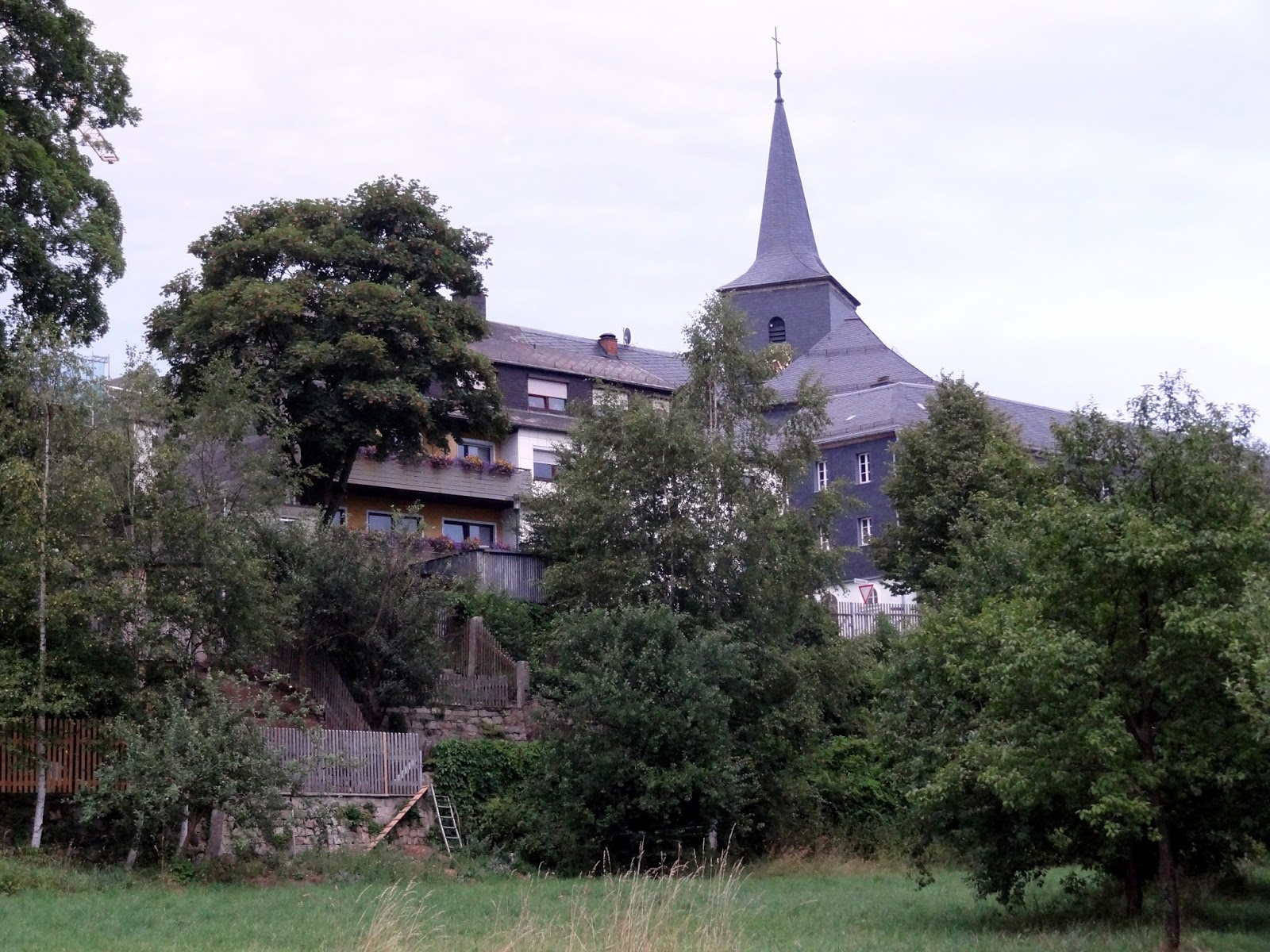
10. The steep hillside from the bridge over the Eger, spire of the church (Lutheran) at top.  The brewery is on the river below the bridge.
11. St. James Lutheran Church, interior.  John Paul was baptized and confirmed here, along with many other generations of Pösches.  The minister here gave Max a copy of the church records of the Pösch family, going back to Peter in 1529. The records previous to that were lost when the church was burned down during the Thirty Years' War.
12. The galleries and organ. I played this organ (Bach, what else?) in 1965.  Hanne said that when she was a child, as in John Paul's day, men and women sat on opposite sides of the sanctuary.
13. The church from the lake side of the hill.

14. Lake Weißenstadt panorama (Hanne and her husband Otto at right).  The original lake was expanded in the 1980s to shore up the region's faltering economic base.  Once an area known for porcelain factories and granite quarries, Upper Franconia fell on hard times.  The much larger lake is now a tourist center, with a huge campground, restaurants, and a fancy spa hotel on its shores. John Paul wouldn't recognize the lake today.
15. Pema bakery shop.  This commercial bakery in Weißenstadt produces heavy whole grain breads that are sold world-wide. To my amazement, my local food co-op, The Wedge, sells this bread. Small world.


16. 19th century houses.  In contrast to the house on the river, these lovely old houses are well maintained. They sit on one of the lanes behind the church.
17. Garages. These structures on the road below the Eger bridge are now used as garages, but in John Paul's day they would have been wagon and equipment sheds.


18. Potato storage sheds. For many decades, townspeople stored potatoes and other root vegetables in these little structures on the outskirts of town. Tilly said that at the end of the war, the townswomen hid in these sheds, fearing what conquering soldiers might do.  However, when the Americans arrived, the woman were relieved to find they had nothing to fear.
19. The Lutheran cemetery (chapel in background).  Generations of Pösches are buried here, including Max and his parents.


20. Looking east. Beyond the mountains in the distance (Oxenkopf, Schneeberg) is the Czech Republic, only 15 miles away. Hanne thinks that the surname Pösch might have Czech origins.

--Photos by Trilby Busch


Sunday, May 27, 2012

Remembering the Fallen

     My earliest recollections of Memorial Day (a.k.a. Decoration Day) were of putting out our four small flags on sticks in the front yard.  The flags would come out again on the Fourth of July, but I can't recall any other day they were displayed.
A soldier places flags on graves at Arlington National Cemetery for Memorial Day.
       Later, in high school,  I associated the day with the community parade that started at the bottom of the hill and wound up at the top on the Catholic side of Homestead Cemetery.  My recollection of those parades evokes rather unpleasant memories: marching uphill in the heavy wool Munhall High School band uniform, tooting my clarinet, and sweating like a racehorse. At the monument, we gathered for what seemed like the same ceremony each year: a Boy Scout reciting the Gettysburg Address, someone reading John McCrae's 1915 poem ("In Flanders fields the poppies blow/ Between the crosses, row on row. . .), a bugler playing "Taps."
     It was appropriate to read Lincoln's famous address at the Gettysburg battlefield on these occasions.  The horrific number of war dead, both Union and Confederate--nearly 700,000, by some estimates--led to the creation of a day to remember them.  Memorial Day was officially proclaimed on 5 May 1868 by General John Logan, national commander of the Grand Army of the Republic.  The day was first observed on 30 May of that year, when flowers were placed on the graves of soldiers from both North and South at Arlington National Cemetery.

     One hundred years later, Memorial Day had morphed from a commemoration of war dead into a more general day of remembering those gone.  As in the 1950s and '60s, today people still visit cemeteries to lay wreaths or plant flowers on the graves of loved ones.  However, in addition to commemorating the dead, Americans use the holiday to mark the beginning of summer--ball games, cookouts, camping, boating, visits to the beach. And for those remaining in the city, there are also those great holiday sales, which bring shoppers flocking to the malls. Times change, and we change with them.
     On Memorial Day my thoughts go out to friends and family members who are no longer with us, especially those who served in the armed forces during WWII:  Uncles Dr. George C. Schein II, Fred Baugher, Joe McGeever (U.S. Army), and Bernie Katilius (U.S. Navy).  And those who witnessed and endured terrible events during their service, my cousin Gilbert Breakwell (U.S.Army, POW in Germany) and my children's grandfather, Dr. C.H.Christensen (Carlson's Raiders, U.S. Navy, Pacific Theater).
Carlson's Raiders on Bougainvillea, one of the battles in which C.H.Christensen served.

     Because of their age during the wars and other circumstances, my father and grandfathers did not serve in the military. However, my paternal great-grandfather, John Paul Busch, served in the U.S. Navy during the Civil War. (He was a fireman on the USS Gunboat Hale at the Battle of  Mobile Bay).  I have often thought it ironic that the skill that saved him from being infantry cannon fodder in the Civil War--the building and tending of fires in industrial boilers)--is what brought him to his death in the Homestead Works nearly 28 years later.
     I also can't help but think of the thousands of others who died in the domestic war that has been going on for centuries, ever since landowners ("nobility") decided that the rest of us should hand over our money and the fruits of our labor to them. After the Industrial Revolution, the combatants became the Company versus the Workers. The Battle of Homestead is the second most bloody clash in a series of many hundreds of violent clashes in the U.S. between the private and public armed forces protecting the interests of company owners and workers demanding fair wages, shorter hours, and/or better working conditions.  Although the official death toll in Homestead was 16, many more died during and after the battle, either by suicide (Pinkertons) or by sabotage (scabs).
     The bloodiest battle came 28 years later in West Virginia at the Battle of Blair Mountain (retold in the 1987 film, "Matewan").  By the end of this battle between striking coal miners and private agents, the sheriff's department, the state police, and the U.S. Army, nearly 15,000 workers and 30,000 police/soldiers were involved. The death toll is estimated between 60 and 120 on both sides, with the workers suffering many more casualties. As in Homestead, the workers ultimately lost.  The result was the setback of miners' rights until the early 1930s when the Federal Government recognized labor unions.
     These were the most bloody confrontations, but there were many others.  To name three: the Lattimer Massacre in Hazelton, PA (1897), when 19 unarmed miners were shot in the back by a sheriff's posse; the Ludlow Massacre (1914)  in Colorado, where the fight between miners and mine guards plus the state militia resulted in 20 or more deaths; the Columbia Mine Massacre, also in Colorado (1927), when mine guards and state police fired a machine gun at striking miners and their wives, killing six and wounding dozens .
Machine gun-equipped armored car, known to the striking miners as the Death Special. The machine gun was turned on the striking Columbia coal miners (mostly immigrants) and used to riddle their tents with bullets. Afterwards, the press whipped public opinion into a frenzy against immigrant workers.
     On this Memorial Day I will remember not only those of my family and of my personal acquaintance who served the country or a cause they believed in, but the many thousands of others, unnamed and often unsung, who served--and sometimes died--trying to make a better life for themselves, their families, and their community.
Poster for "Matewan": "It takes more than guns to kill a man."
 "You think this man is the enemy? Huh? This is a worker! Any union keeps this man out ain't a union, it's a goddam club! They got you fightin' white against colored, native against foreign, hollow against hollow, when you know there ain't but two sides in this world - them that work and them that don't. You work, they don't. That's all you get to know about the enemy." 
--Joe Kenehan (Chris Cooper) in "Matewan"