Showing posts with label homestead strike of 1892. Show all posts

Thursday, July 5, 2012

After the Battle Ended

     One hundred twenty years ago, around 3 o'clock on the morning of July 6th, striking workers at the Homestead Works of Carnegie Steel, on the watch downriver from the mill, spied two large barges being hauled upstream by a single tug boat.  They spread the word by telegraph, steam whistle, and horse messenger.  By the time the barges reached the landing site at the Works two hours later, thousands of townspeople stood on the steep banks of the Monongahela River, determined to stop whomever--scabs or guards--from entering the mill.
     The workers did stop the Pinkerton guards on board from disembarking--the only time in American labor history that the workers held off militia during a confrontation.  But it took a ten-hour running gun battle to do so, ending with the deaths of nine strikers and seven Pinkerton guards (The exact number is disputed, but the total surely exceeded these numbers on both sides).
The battle as illustrated in the  National Police Gazette, July 23, 1892
     Most accounts of the 1892 Homestead Strike cover the events of 1892-93, but do not go into what happened to the town in the long run--except to say that the company successfully stopped union organizing in the steel industry for nearly 40 years. (A notable exception is William Serrin's 1993 work, Homestead: The Glory and Tragedy of an American Steel Town, which traces the history of the town up to the closing of the Works).  When Hamlin Garland visited Homestead in 1893, he found the town "squalid and unlovely," a casualty of the failure of the strike and the so-called Panic which had plunged the US into a severe depression.
     Nevertheless, some former strikers who were blacklisted from steelmaking  managed to find work and remain in town.  The descendants of two of these strikers are the Debolt family, which still operates a bus company out of Homestead, and my cousin Grace Jack Krepps.  In fact, Grace and her brother Ronnie are some of the few people who can say they had grandfathers on both sides of the Strike--Jack (striker) and Busch (replacement worker).
       Grace told me that after her Grandfather Jack lost his job in the Works, he found another at the Homestead water works.  He didn't want to have anything to do with steel making, but he did not stop his son David, Grace's father, from taking work in the mill.  Dave Jack became a roller, a skilled worker who shaped hot steel into finished products.
A rolling mill crew from the Homestead Works, 1906 (photo from Gaughan collection, U of Pittsburgh)
    During my first visit to New York City in 1955, my parents took me on a visit to the Empire State Building.  "Your Uncle Dave rolled the beams used to the build this," Dad said, pointing upward.  At that time, the Empire State Building was the tallest building in the world, an engineering marvel that is still admired today.  I accepted Dad's word on faith, but found corroboration of this claim via a TV documentary about the construction of the building (1930-31).  The beams were on rush order from the Homestead Works, rolled in the structural mill and placed on fast freight trains headed for New York.  The delivery was so speedy that often the beams were still warm from rolling when they arrived at the building site.
The famous photo of a high-steel crew resting on one of the beams used to construct the Empire State Building. This is not Photoshopped.  The workers are hundreds of feet up, with no safety net or ropes. The death toll during the construction phase was one fatality per floor, with a total of over 100.
     Despite these success stories, however, the large majority of 1892 strikers were not re-hired and forced to look for work elsewhere, in another industry.  For example, John McLuckie, the former Homestead burgess and strike leader, wandered out West, eventually finding work as a foreman for the Sonoma Railroad in Mexico.  Who knows what happened to hundreds of other outcasts from the mill who left town, never to return?
       The descendents of those who replaced the strikers--myself included--understandably did not dwell on this aspect.  Everyone, unionist or scab, got the message of the strike's outcome:  Don't mess with H.C Frick and Carnegie Steel, for you will lose.  In those days, as now, property rights were held sacred in the United States.  Those who own the property can rely on the government at all levels-- local, state, and federal-- to send in troops to "restore order" in labor disputes, as they have countless times before and after the 1892 strike.
Federal troops fighting striking workers during the violent Railroad Strike of 1877.  Over a hundred people died, but the outcome was the same as with all 19th century strikes:  a victory for the company.
      The English critic and reformer John Ruskin, writing 42 years before the strike, observed: “In order that people may be happy in their work, these three things are needed: they must be fit for it; they must not do too much of it; and they must have a sense of success in it.” (Pre-Raphaelitism, 1850)  By this yardstick, very few, if any, workers in the Homestead Works before or after the strike could have been happy.
     When those thousands of strikers and townspeople rushed down to the river to stop the Pinkertons in the early morning hours of July 6, 1892, they thought they were waging a just war against the company.  Whether or not their cause was seen as just depended on the point of view of the observer.
     Yet the fact remains that in entering into battle with the company-hired Pinkertons, the workers of Homestead did an amazing, unique feat: the defeat of a trained, armed militia by a motley assemblage of workers.  For that, the name Homestead will always have a special place in American history.
The fortified Homestead Works aka "Fort Frick."  In the weeks before the battle the company erected a fence around the entire mill site.  During the battle, the workers broke through the fence, but mended it the next day, naively assuming that they would soon be returning to work.

Sunday, May 27, 2012

Remembering the Fallen

     My earliest recollections of Memorial Day (a.k.a. Decoration Day) were of putting out our four small flags on sticks in the front yard.  The flags would come out again on the Fourth of July, but I can't recall any other day they were displayed.
A soldier places flags on graves at Arlington National Cemetery for Memorial Day.
       Later, in high school,  I associated the day with the community parade that started at the bottom of the hill and wound up at the top on the Catholic side of Homestead Cemetery.  My recollection of those parades evokes rather unpleasant memories: marching uphill in the heavy wool Munhall High School band uniform, tooting my clarinet, and sweating like a racehorse. At the monument, we gathered for what seemed like the same ceremony each year: a Boy Scout reciting the Gettysburg Address, someone reading John McCrae's 1915 poem ("In Flanders fields the poppies blow/ Between the crosses, row on row. . .), a bugler playing "Taps."
     It was appropriate to read Lincoln's famous address at the Gettysburg battlefield on these occasions.  The horrific number of war dead, both Union and Confederate--nearly 700,000, by some estimates--led to the creation of a day to remember them.  Memorial Day was officially proclaimed on 5 May 1868 by General John Logan, national commander of the Grand Army of the Republic.  The day was first observed on 30 May of that year, when flowers were placed on the graves of soldiers from both North and South at Arlington National Cemetery.

     One hundred years later, Memorial Day had morphed from a commemoration of war dead into a more general day of remembering those gone.  As in the 1950s and '60s, today people still visit cemeteries to lay wreaths or plant flowers on the graves of loved ones.  However, in addition to commemorating the dead, Americans use the holiday to mark the beginning of summer--ball games, cookouts, camping, boating, visits to the beach. And for those remaining in the city, there are also those great holiday sales, which bring shoppers flocking to the malls. Times change, and we change with them.
     On Memorial Day my thoughts go out to friends and family members who are no longer with us, especially those who served in the armed forces during WWII:  Uncles Dr. George C. Schein II, Fred Baugher, Joe McGeever (U.S. Army), and Bernie Katilius (U.S. Navy).  And those who witnessed and endured terrible events during their service, my cousin Gilbert Breakwell (U.S.Army, POW in Germany) and my children's grandfather, Dr. C.H.Christensen (Carlson's Raiders, U.S. Navy, Pacific Theater).
Carlson's Raiders on Bougainvillea, one of the battles in which C.H.Christensen served.

     Because of their age during the wars and other circumstances, my father and grandfathers did not serve in the military. However, my paternal great-grandfather, John Paul Busch, served in the U.S. Navy during the Civil War. (He was a fireman on the USS Gunboat Hale at the Battle of  Mobile Bay).  I have often thought it ironic that the skill that saved him from being infantry cannon fodder in the Civil War--the building and tending of fires in industrial boilers)--is what brought him to his death in the Homestead Works nearly 28 years later.
     I also can't help but think of the thousands of others who died in the domestic war that has been going on for centuries, ever since landowners ("nobility") decided that the rest of us should hand over our money and the fruits of our labor to them. After the Industrial Revolution, the combatants became the Company versus the Workers. The Battle of Homestead is the second most bloody clash in a series of many hundreds of violent clashes in the U.S. between the private and public armed forces protecting the interests of company owners and workers demanding fair wages, shorter hours, and/or better working conditions.  Although the official death toll in Homestead was 16, many more died during and after the battle, either by suicide (Pinkertons) or by sabotage (scabs).
     The bloodiest battle came 28 years later in West Virginia at the Battle of Blair Mountain (retold in the 1987 film, "Matewan").  By the end of this battle between striking coal miners and private agents, the sheriff's department, the state police, and the U.S. Army, nearly 15,000 workers and 30,000 police/soldiers were involved. The death toll is estimated between 60 and 120 on both sides, with the workers suffering many more casualties. As in Homestead, the workers ultimately lost.  The result was the setback of miners' rights until the early 1930s when the Federal Government recognized labor unions.
     These were the most bloody confrontations, but there were many others.  To name three: the Lattimer Massacre in Hazelton, PA (1897), when 19 unarmed miners were shot in the back by a sheriff's posse; the Ludlow Massacre (1914)  in Colorado, where the fight between miners and mine guards plus the state militia resulted in 20 or more deaths; the Columbia Mine Massacre, also in Colorado (1927), when mine guards and state police fired a machine gun at striking miners and their wives, killing six and wounding dozens .
Machine gun-equipped armored car, known to the striking miners as the Death Special. The machine gun was turned on the striking Columbia coal miners (mostly immigrants) and used to riddle their tents with bullets. Afterwards, the press whipped public opinion into a frenzy against immigrant workers.
     On this Memorial Day I will remember not only those of my family and of my personal acquaintance who served the country or a cause they believed in, but the many thousands of others, unnamed and often unsung, who served--and sometimes died--trying to make a better life for themselves, their families, and their community.
Poster for "Matewan": "It takes more than guns to kill a man."
 "You think this man is the enemy? Huh? This is a worker! Any union keeps this man out ain't a union, it's a goddam club! They got you fightin' white against colored, native against foreign, hollow against hollow, when you know there ain't but two sides in this world - them that work and them that don't. You work, they don't. That's all you get to know about the enemy." 
--Joe Kenehan (Chris Cooper) in "Matewan"

Tuesday, April 17, 2012

Places in the Novel Today

The Homestead Works of Carnegie Steel (cum United States Steel) is gone, replaced by the large Waterfront shopping and entertainment complex.  And most of the buildings on Eighth Avenue were erected in the 20th century.  Nevertheless, a visitor can get some idea of what the town was like.  Here are some photos of the sites in Homestead today.
The intersection of 8th Avenue and Ann Street.  The buildings on either side of Ann were there in 1892.
The 300 block of E. Eighth Avenue, location of the doctor's office.
The 200 block, location of the saloon Emlyn visited with Gwyn.  The larger buildings were built in the 1910s.
The view west from the Amity Street crossing, with the depot at right. In 1892 a different depot stood in the same place. The locomotive approaching the station is hauling a 100-car freight train, headed eastward to Horseshoe Curve.
The railroad depot in Homestead today, now used as offices for the Allegheny County District Attorney. The depot, built 1906, is on the National Register. It was used as a passenger depot until the 1960s.
The view east from the crossing.  In 1892 hotels and other commercial buildings stood  in the current green area between these and  the tracks (not visible) off to the left.

The site of the mill's General Office Building, now a bank.  The office structure was destroyed by fire in 1942.
The view from the front of the Carnegie Library.  In 1892 the General Office Building would have stood just below where St. Michael's Church stands today. The mill complex was where the buildings can be seen in the distance.
Looking down the front steps of the Carnegie Library.  The current library is sited on the hill where people watched the Battle of Homestead unfold at the river, and where the troops of the Pennsylvania Militia were camped later.
The brick house on Tenth Avenue that served as the model for the exterior appearance and location of the Oesterlings' house.
The house on Eleventh Avenue where the author's Aunt Helen McGeever and her family lived in the 1940s. It served as the model for the interior of the Oesterling's house.
The Bost Building, headquarters for the Amalgamated during the lockout and strike.  Reporters watched the town and mill  from the roof of this building before and during the battle.  Today it is the home of Rivers of Steel National Heritage Area.
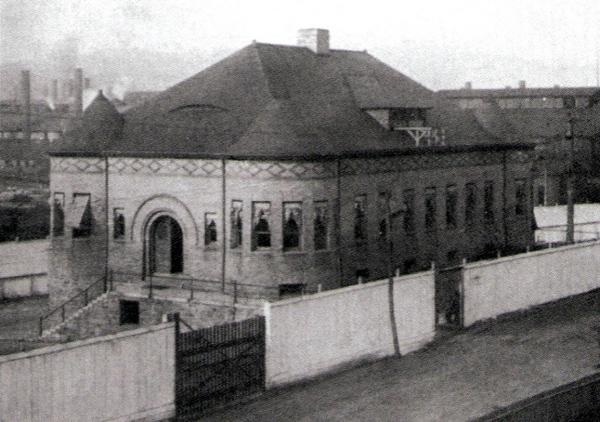
The mill Pump House, the only remaining structure from the 1892 battle site.  Today it is used by Rivers of Steel .   Emlyn, Gwyn and the others were on the roof of the Pump House during the battle.
A boat pushing barges of coal up the Monongahela River at the battle site.  In 1892 the barges holding the Pinkerton guards were at the mill landing, out of view on the river below.  The stone pylons of the Pemikey Railroad bridge of 1892 are visible on the newer bridge in the background.
The concrete overlook at the battle site today.  (l-r) Ceridwen Christensen, Jay-Louise Weldon, Trilby Busch
Anne Ashley Memorial Methodist Church, built 1887. It is still a thriving congregation. Sarah and Emlyn ride their horses past it, and Montague was thrown from Figaro near here.
The view today from where Emlyn sat on Easter Sunday. Only the gravesites on top of the hill in the distance would have been there in 1892.
The Jones-Phillips house stood here, somewhere in the parking lot of a Target store.  In 1937, the entire First Ward, where this house would have been located, was razed for the expansion of the Homestead Works.

Tuesday, January 24, 2012

So Depressing! Part 2: Lockouts

When I opened my copy of the New York Times yesterday, my eyes immediately jumped to a front-page article titled "More Lockouts as Companies Battle Unions."  The article notes the recent employment (pun intended) of the lockout, not only in professional sports, but also in such diverse industries as manufacturers (Cooper Tire) and the arts (the New York City Opera).

Continued in the Business section, the article observes that the use of the lockout was "once a rarity," and goes on on to highlight the ongoing dispute between American Crystal Sugar, based in Moorhead, Minnesota, and its unionized workers.  Since the lockout began on August 1st of last year, the company has hired 900 replacement workers to keep its sugar beet plants running.  Thanks to Federal regulations, unlike 19th century Robber Barons, American Crystal cannot make make scabs permanent hires.  However, these regulations may not be enough to save the 1,300 workers struggling without paychecks in a depressed economy.

A locked-out worker walks by an American Crystal plant.
As the lockout drags into its seventh month, the locked-out workers are sinking into financial ruin.  Many have defaulted or will soon default on their mortgages; many bills and insurance policies have not been paid. Layoffs are starting in other sectors, like education.  In this war of attrition, the company has the upper hand.  How long can these people hold on before, like the Carnegie Steel workers in 1893, they are forced to give up and try to move on?  The economic ripple effect of the lockout is spreading through the Red River Valley. I ask you, who is benefiting from this situation?  Replacement workers, union members, public workers, taxpayers?  Not.
Pickets on the line at American Crystal in the January cold.
Sugar workers in default on their mortgages are not being thrown into the street by sheriff's deputies, as they were in 1892 Homestead--at least not yet.  But nationwide, we've witnessed homeowners, deep in debt on properties bought during the housing bubble, kicked out by the same banks that caused the crash in the first place, banks bailed out by American taxpayers.  Then, maddeningly, those banks put the house up for sale at a price below what the dispossessed owner owed.  Crazy, crazy.      
As in all of these company vs. labor disputes, the two sides have very different perspectives.  Labor attorney Robert Batterman (metaphorical name?),who represents companies, declared that "the pendulum has swung too far toward the unions, and in these tight economic times employers are looking for givebacks."  But according to union member Paul Woinarowicz, the lockout is "just another way of trying to break the union." As in 1892 Homestead, the Red River Valley community has been torn apart by the pitting of worker against worker. As Woinarowicz put it, "[Being locked out] was just like a knife stuck in your heart."

Members of the Pennsylvania militia on patrol in Homestead, securing the mill for replacement workers, 1892.
In an ironic twist, it turns out that American Crystal Sugar is a co-op, formed in 1973 when growers bought out a corporation founded in the 1890s.  Co-ops have long enjoyed the image of the "Little Guys" banding together to get free of "The Man."  However, some co-ops have become huge companies, with boards of directors far removed from the workers toiling in their plants.  These company executives and boards have their eyes on the bottom line, just as do those in same roles in corporations.   
During the Homestead lockout, anarchists came to town to urge the workers to take over the mill.  The workers threw them into jail.  What the anarchists did not understand is that American workers did not want to run the company; they wanted decent pay and decent working conditions.  How ironic, then, that American Crystal actually is a company that was taken over by the farmers that the corporate company was kicking around.  Now they've been in charge for forty years, they are acting like the company they took over.
A Trygve Olson editorial cartoon.

American Crystal has spent a lot of cash keeping government subsidies flowing their way.  According to opensecrets.org, through the first years of this century, the co-op's PAC routinely spent between $300,000 and $600,000 each election cycle. Again, irony:  the same elite minority that want to keep their own tax percentage low are asking the rest of us taxpayers to keep subsidizing their profits. But alas for American Crystal, despite their efforts, it's virtually guaranteed that the government subsidies on sugar will be taken away in the next congressional session.  On top of that, a bad crop last year caused a drop of 39% in company profits.What to do?  Take a lesson from H.C. Frick and cut employees' earnings to shore up your bottom line.


Looking at nightmarish economic and political turmoil in the nation and world, it's tempting to give into despair. However, throwing in the towel never changed anything for the better. Take to heart the message of Mother Jones, champion of the Little Guy: "Pray for the dead and fight like hell for the living."
Mother Jones exhorts workers to stand up for their rights.

Monday, July 4, 2011

Subterranean Homesick Blues 2011

"Well, I rapped upon a house
With the US flag upon display.
I said, 'Could you help me out,
I got some friends down the way.'
The man says, 'Get out of here
I'll tear you limb from limb.' 
I said, 'You know, they refused Jesus, too.' 
He said, 'You're not him.'"
--"Bob Dylan's 115th Dream"

One hundred and nineteen years ago on July 4th, the inhabitants of Homestead, Pennsylvania, were on edge.  The Fourth of July was one of just two days off annually for the workers at Carnegie Steel, the other being Christmas.  Only this year, 1892, was different.  On Saturday, July 2nd, the company had paid off all workers and served notices of discharge.  Andrew Carnegie was off in his castle in Scotland, letting Henry Clay Frick handle the situation. Frick had ordered a lockout.  He had called in the Sheriff to deal with the workers, but they had overpowered the lawmen and sent them away.  Frick then decided to bring in a private militia, the Pinkertons, to handle the workers.  The mercenaries were on their way by rail to Pittsburgh, where they would be loaded into barges and brought to Homestead.  The majority of these soldiers, many of them young men who had signed on for temporary summer work, had no idea how dangerous their job was going to be.
 
On this steamy, drizzly Monday, Homesteaders tried to carry on with their usual Fourth activities, but their hearts weren't in it.  Over the town hung the shadow of impending violence.  Most townspeople believed that Frick would try to bring in scabs via the river, as the deputies' arrival by land had been thwarted.  The workers, armed with guns, some dating back to the Civil War, patrolled the roads and lined the river banks, on the alert for the next assault.
 
 The confrontation between company soldiers and the workers came at daybreak on the morning of July 6th.  Very few on either side had any idea that this confrontation would blossom into a full-fledged battle that raged throughout the hot afternoon.  Frick, however, did know of the likelihood of war on the riverbank.  He had to know, as he had brought in both private and public militia to protect corporate interests on occasions before that, and they had all ended with one or both sides suffering casualties.  What he probably didn't understand was the steely (pun intended) determination of the Homestead workers.  
Usually, historical accounts of the Battle for Homestead focus on the casualties of the battle itself.  What they do not relate are the stories of the countless casualties that came afterward: strikebreakers killed by explosions and poison, strikers' lives claimed by despair and heartbreak.  The stories of these casualties have not been told in print. The company kept a lid on unionist sabotage at the mill because they didn't want to scare away new workers.  Many of the strikers, demoralized and starving, moved away, leaving the town to the company and its scabs. 

As a child, I heard the story over and over of my Great-Grandfather Busch's post-battle death in a boiler explosion set by unionists.  It made me anti-union.  In the 'Sixties and 'Seventies, the steelworkers' union was at the peak of its power and influence.  Workers who had not completed ninth grade were making two or three times what my father made as a teacher with a master's degree.  It didn't seem fair.

In 1986, three years after the Homestead Works shut down, I found myself confronted with the choice of whether or not to join a union, the union for faculty in the Minnesota State College and University system.  One had to pay one's fair share anyway, so I chose to join and thereby have some control over union decisions.  It took a few years, but I eventually realized that if it were not for the union, as an adjunct, I would be doing the same work for far less than full-time instructors, unable to build seniority, unsure of whether I'd be hired back during the next semester. 

Thanks to a fair and decent dean, Manley Olson, and a department chair, Karen Gleeman, who worked tirelessly to support adjunct faculty, I was hired as a full-time faculty member in 1992, assuming the rights and privileges attendant thereof--many of these acquired by union representation at MNSCU negotiations.  I enjoyed these benefits throughout my teaching career, but the situation started to change during the last few years.  When I retired in 2006, the department had more adjuncts than tenured faculty.  New hires did not get anything like the salaries and retirement packages my generation enjoyed.  I got in and out just in time.

Now, five years later, the situation with public unions is far worse than many of us could ever have envisioned.  With Wisconsin in the lead, many states are slashing away at unions, rescinding the workers' collective bargaining rights.  Governments at all levels are cutting away at publicly funded programs such as medical care for the aged, poor, and vulnerable, and police and fire departments.  Few would argue that we do not have to tighten our belts, to sacrifice some of the government benefits we've enjoyed for so long. What I don't understand is prevailing attitude among supporters of draconian cuts that these are all we need to set things right with the economy.  How conveniently they forget that it was the unbridled greed of banks, corporations and "investors" that took down the U.S. economy in 2008.  How easily they forget that it was the Bush administration that, while dragging the country into two extremely costly wars abroad, let this blind rapaciousness run unfettered. 

Take, for example, former Minnesota Governor Tim Pawlenty.  He is trying to fuel his run for the presidency by bragging about what he did for the state during his tenure.  Go ahead and brag, smug Timmy, about how your "no-new-taxes" policy threw millions of dollars of tax burden onto the middle-class, especially city dwellers, who have been forced to live with much less while paying much more.  My property taxes more than doubled during your governorship, while my property value plummeted. You don't fool me, nor apparently 94% of your targeted Tea Party supporters, who are backing other candidates.

As I see it, the government of the state of Minnesota is shut down now, at a loss of millions in state revenue, for one reason and one reason only: Governor Mark Dayton's insistence that the wealthiest 1% Minnesotans pay their fair share of the tax burden.  There is no way to justify their refusal to shoulder a bit more of the burden to keep the state solvent.  Have we reached such a sad pass that the greedy rich have the state and nation in their grip so tightly that they are willing to the country go to hell before giving up even a little of their wealth? 

Doesn't it get you angry that Big Business and Big Government, bolstered by a stacked Supreme Court, have been methodically funneling the nation's resources into the coffers of the big banks, big oil companies, and big corporations for years now?  Doesn't it get you angry that this small minority--and their corrupt judges and public officials--want you and me to keep sacrificing so they can keep biggering and biggering?

If so, speak out.  I'm not arguing for you to grab a rifle and head for the riverbank. Just let the moneybags and their minions know that you are tired of their jive.  Unlike Homesteaders in 1892, you don't even have the option of moving to somewhere with better opportunities.  Where are you going to go--Iceland?  Greece? 

As Ben Franklin put it, if we don't hang together, we will hang separately.