Friday, November 11, 2016

Damn the Torpedoes!


Deck officers on the USS Susquehanna, 1864. Source: Civil War Talk web site
When I was teaching, as an end-of-semester "fun" writing assignment, I'd have my students collect a story and retell it in their own words. By far the greatest number turned out to be family immigration stories--stories passed down from several generations as well as stories fresh in the memories of those who experienced it. Just about every single one, even if badly told, was fascinating. For example: the Swedish immigrant who walked from Willmar to Minneapolis (95 miles) carrying two heavy sacks of flour to sell because he couldn't afford to pay for transportation. Or the Vietnamese man who was on a boat that was sunk as they were fleeing the country, drowning half of the people on board.

But today, Veteran's Day, I'd like to tell one of my own family immigration stories, the tale of how Johann Paulus Pösch, citizen of Bavaria, became John Paul Busch, citizen of the U.S.A.
The old portrait of John Paul that used to hang in my grandfather's house, surrounded by Busch family photos (left) and beer steins from his native Weißenstadt (below).

The year was 1863, and the U.S. was embroiled in the some of the darkest days of the Civil War. In Europe, Prussian Chancellor Bismarck was in a territorial dispute with Denmark over Schleswig-Holstein, accompanied by sabre-rattling. Twenty-three-year-old Johann Paulus Pösch of Weißenstadt, near the border with Bohemia (now the Czech Republic), trained as a tanner, decided to pack up and emigrate to the United States. When he arrived in the port of Philadelphia, immigration officials asked him if he'd like to become a U.S. citizen on the spot. His answer, of course, was "Ja."

The kicker was that he then had to serve in the U.S. military. As John Paul Busch he joined a U.S.Army division consisting of German immigrants like himself, where officers asked him about skills that might be applied to his service. Apparently there was zero need for tanners in the Army, but when he told them that he had learned how to fire boilers making beer in the civic brewery back in Weißenstadt, he got their attention. He was whisked off straightaway to become a member of the U.S.Navy.

John Paul served as a fireman--a skilled job involving firing the boiler of the engine driving the ship--on two gunboats. The gunboats were part of the blockade of Confederate ports, trying to choke off supplies and trade from Europe. In the summer of 1864 the second of these, the USS E.G. Hale, was assigned to serve under Rear Admiral David G. Farragut in the Gulf coast off Mobile, Alabana. At that time Mobile was the Confederacy's last large port open on the Gulf, and to protect it, they had placed hundreds of tethered naval mines (then called "torpedoes") in the bay.
USS Water Witch, a gunboat that served with the USS Hale
Source:  US Navy Historical and Heritage Command 
 Farragut aimed to shut down the port of Mobile. In coordination with the Army, he assembled a force of 5,500 men on 12 wooden ships, four ironclad monitors, and two gunboats (one of them the Hale), and on August 5, 1864, Farragut ordered his fleet to charge the bay. But when the monitor USS Tecumseh struck a mine and sank, the others began to withdraw.

Suffering from an attack of vertigo during the assault, Farragut was lashed to the rigging of his flagship the USS Hartford. Seeing the ships of his fleet hesitating, Farragut shouted through a trumpet to a neighboring vessel, "What's the trouble?" "Torpedoes," its captain yelled back. "Damn the torpedoes!" shouted Farragut, "Four bells, Captain Drayton, go ahead. Jouett, full speed."

"The Battle of Mobile Bay" by Louis Prang (1884) Library of Congress Archives At lower left the two US gunboats are shown doing battle with the Confederate ironclad.

In this daring assault, the bulk of the U.S. fleet succeeded in passing through the mine field, thus avoiding the guns of the three forts guarding Mobile Bay. The last remaining Confederate ironclad vessel, the CSS Tennessee, fought valiantly, but was eventually reduced to a motionless hulk, and the crew surrendered. With no Navy to support them, the three Confederate forts also surrendered within days. Complete control of lower Mobile Bay thus passed to the Union forces, and the blockade of the Confederacy was complete.

Busy firing the gunboat's boiler, John Paul probably saw nothing of the battle itself.  But I'm sure he must have heard the explosions and chaos going on around the Hale in Mobile Bay. At the end of the war, the Navy presented John Paul with a Bible for his service. My dad's sister Irene, knowing how much I am into family history, gave this Bible--or rather, what's left of it--to me.

The back pages of the now-tattered King James Bible presented to John Paul by the US Navy

Every Veteran's Day I think of Great-Grandfather John Paul Busch, who became an instant citizen and instant service member back in the terrible days of the Civil War. John Paul, I salute you and all the other veterans who have served to keep our country united, strong, and safe.

Veterans, here's to you.

The crew of the gunboat USS Hunchback that served on the James River in Virginia, 1864-1865. Note that about a fifth of the crew is African-American. Source: U.S. Naval History and Heritage Command

Wednesday, August 17, 2016

Hard Times Cotton Mill Girls

Yorkshire has recently got a lot of publicity out of PBS's soapy series, "Downton Abbey", allegedly set there. What many people don't realize, however, is that the stately home used for the filming, Highclere Castle, is many miles away in posh Hampshire in the south of England. You'd never know from watching "Downton Abbey" that Yorkshire, in the north of the country, is historically best known for its moors, mills, mines, and religious reformers.
1820's workers row houses in Knaresborough, North Yorkshire.

I recently traveled to Yorkshire to visit Knaresborough, the native town of a Minneapolis master builder (See  "Henry Ingham's Yorkshire."). Being interested in industrial history, I hired a guide, Keith Britton, to take me around to relevant sites in the county, the largest in England. We concentrated on the West and North sections where many of the industrial centers are located. Cities in West Yorkshire developed during the industrial revolution include Bradford (textiles), Leeds (transportation, textiles), and Wakefield (coal mining).

Knaresborough, North Yorkshire. The old linen mill was located on the River Nidd below the railroad viaduct.
What I found was a curious and sad incongruity between the quality of technology vs. the quality of the workers' lives.  Technological advancement and engineering marvels of nineteenth-century Britain are indeed impressive--as were the dangers to life, limb, and health of the workforce.

Let's start with mining. We visited the National Coal Mining Museum for England in West Yorkshire and got a tour of what was a working mine not too long ago. We heard the stories of the darkness, cramped and hot working conditions, dangerous machinery, rats, the stench, child labor, explosive gases, and deadly flooding. I've also visited the Big Pit mine in Wales and mines in Pennsylvania, where the stories are similar.
Headstock of the Capshaw Colliery, now part of the coal mining museum
The more recent the mining machinery, the more dangerous--big and fast. Most of the shaft/pit coal mines in Britain and America are now closed, replaced by strip mining. Nevertheless, an estimated 12,000 workers are still killed annually worldwide in the coal mining industry (BBC News, 2010).
The Clydesdale draft horse playing "pit pony" at the museum contemplates lunch. He has a much better life than the real pit ponies, who worked and died in the darkness and filth of the coal mine.
We visited two 19th century textile mills, which offered glimpses into what life was like for the workers 150 years ago. Saltaire Village near Bradford is named after Sir Titus Salt who in 1853 built a textile mill on the River Aire. When completed, Salts Mill was the largest industrial building in the world by total floor area. Salt also constructed a town, Saltaire Village on the site for his workers, a project that's been heralded for its enlightened urban planning. In mid-century Britain, this owner-built town was far better workers' housing than offered in the slums of nearby Bradford.
Part of the huge Salts Mill complex
 The Saltaire site is interesting because it has been saved as a commercial property instead of as a museum. In 1986 the woolen mill closed, and the next year entrepreneur Jonathan Silver took up the daunting task of redeveloping the complex. Thanks to his efforts, Saltaire today is a successful shopping and arts center. The sturdy brick workers' houses have been rehabbed and sold to private individuals.  In 2001, Saltaire was designated a World Heritage Site by UNESCO.
Windows installed in a former mill room in the arts wing of Saltaire.
My guide Keith enjoying a tea break at the Saltaire cafe.
The large bookstore in Saltaire. The complex also houses a wonderful housewares store.
The mill exterior by the canal. Nineteenth century mills were often dependent on water power.
On seeing Saltaire, I immediately thought of the textile mills in Massachusetts, which I wrote about last year ("Remaking Industrial America"). As it turns out, there is a strong connection between the textile mills in Bradford and those in Lawrence, Massachusetts. (Read the details here.)
Between the mill buildings at Saltaire.

Despite the successes of the paternalistic ethos of Salt and other mill owners, friction between the textile industrialists and their workers inevitably escalated. Among other cost-saving measures, mill owners constantly tried to replace male workers with cheaper female ones. But unlike in the U.S., in Bradford trade unionism was notoriously weak. In the 1870s the owners of Salts Mill broke a strike by using the strategy of a lockout (sound familiar?).

In contrast to the privately developed Saltaire complex is the Quarry Bank Mill in nearby Cheshire, a National Trust property that predates Salts Mill by seven decades. In 1783, Irish-born Samuel Greg found the perfect spot for his new cotton mill on the River Bollin, harnessing the flow of the river to power the mill. Like Salt, Greg built on-site housing for his workers, carrying on the paternalistic tradition found in textile mill owners on both sides of the Atlantic.
Quarry Bank Mill 

What's fascinating about Quarry Bank Mill is the assortment of working textile manufacturing machinery on display. The museum takes visitors through the historic process of spinning and weaving cotton fabric, from hand-spinning and weaving to power looms. When the machinery is running, it becomes very obvious why workers usually lost most of their hearing within a year.

1926 spinning mules in operation:

                                                
                                      1790's water power loom weaving shirting material:
 

 The first mills were powered by water wheels on fast-moving streams. Here's a video of water flowing from a holding pond onto an 1840's overshot wheel powering an old flour mill in Wales:


But to power a mill as large as Quarry Bank, a huge wheel was required. The "Great Wheel" installed at the mill in 1818 was 21 feet wide and 32 feet in diameter. The wheel was an undershot wheel, with the water pouring in from the back near the bottom of the wheel. This gives a definite mechanical advantage over the older overshot wheels. From 1810 on, steam turbines generated additional power for the mill.
The water wheel currently powering the mill is 25 feet in diameter. It is of similar design to the Great Wheel and was brought from a mill in North Yorkshire.
As in coal mining, airborne particles generated by the textile mills' operation caused a number of disabling and often fatal lung diseases, including "brown lung" and COPD. And as in other industries, accidents involving large, fast-moving machinery caused many deaths and horrible injuries. Long working hours with few breaks contributed to hazards for exhausted workers--often children and women.

"Yorkshire, West Riding"--Photo by B. Hobson, 1921. Which was worse, the air inside or outside?
Whether coal, textiles, or steel industries, life for workers during the 19th century was often nasty, brutish, and short. I find it one of the great ironies of Andrew Carnegie's career that his family emigrated to the U.S from Scotland in 1848 because his father, a handloom weaver, was put out of work by the textile mills. While Carnegie was quite bitter about his family's exit from the old country as paupers, he apparently had few concerns about the hand workers and artisans forced to find work in his mills. Carnegie aimed to settle the score by buying a castle in Scotland, where he could lord it over his former countrymen--a castle where he was staying during the summer of 1892, far from the squalor and violence in Pittsburgh.

The history of the industrial revolution has many, many chapters, most of them not pretty. Still, the lives of fantasy English aristocrats don't interest me nearly as much as the lives of the millions of industrial workers in Britain and North America. For many of us from Pennsylvania, as with many from Yorkshire and all the other industrial places of the world, these stories are our family stories.

The song and old photos are American, but the experience of these textile workers is universal:

 "Hard Times Cotton Mill Girls"
Power loom at Quarry Bank Mill

Suggested reading, Social Novels:
Sybil, or the Two Nations by Benjamin Disraeli (1848). Deals with the conditions of the working classes.
Shirley by Charlotte Bronte (1849). Set in Yorkshire during the Luddite uprisings.
North and South by Elizabeth Gaskell (1855). Based on Gaskell's experiences in industrial Manchester. Adapted for television in 1975 and 2004.
Suggested viewing.
Detective series set in the North of England.
Vera. ITV. Set in contemporary Northumberland.
Inspector George Gently. BBC One. Set in 1960s North East England (Newcastle, County Durham)
Film.
Brassed Off (1996). Comedy-drama about coal miners in a North England town where the colliery may be closed.
Cambrian Woollen Mill just north of Llanwrtyd Wells is one of the few remaining operational woolen mills in Wales.The brick mill building dates from the 1820s. In the 1990s I bought a Welsh tapestry coverlet here. Today their production is limited to smaller items such as tartan scarves.

--Except where noted, all photos were taken by Trilby Busch. Please credit if you reuse.

Thursday, February 11, 2016

Braddock's Defeat, 1980

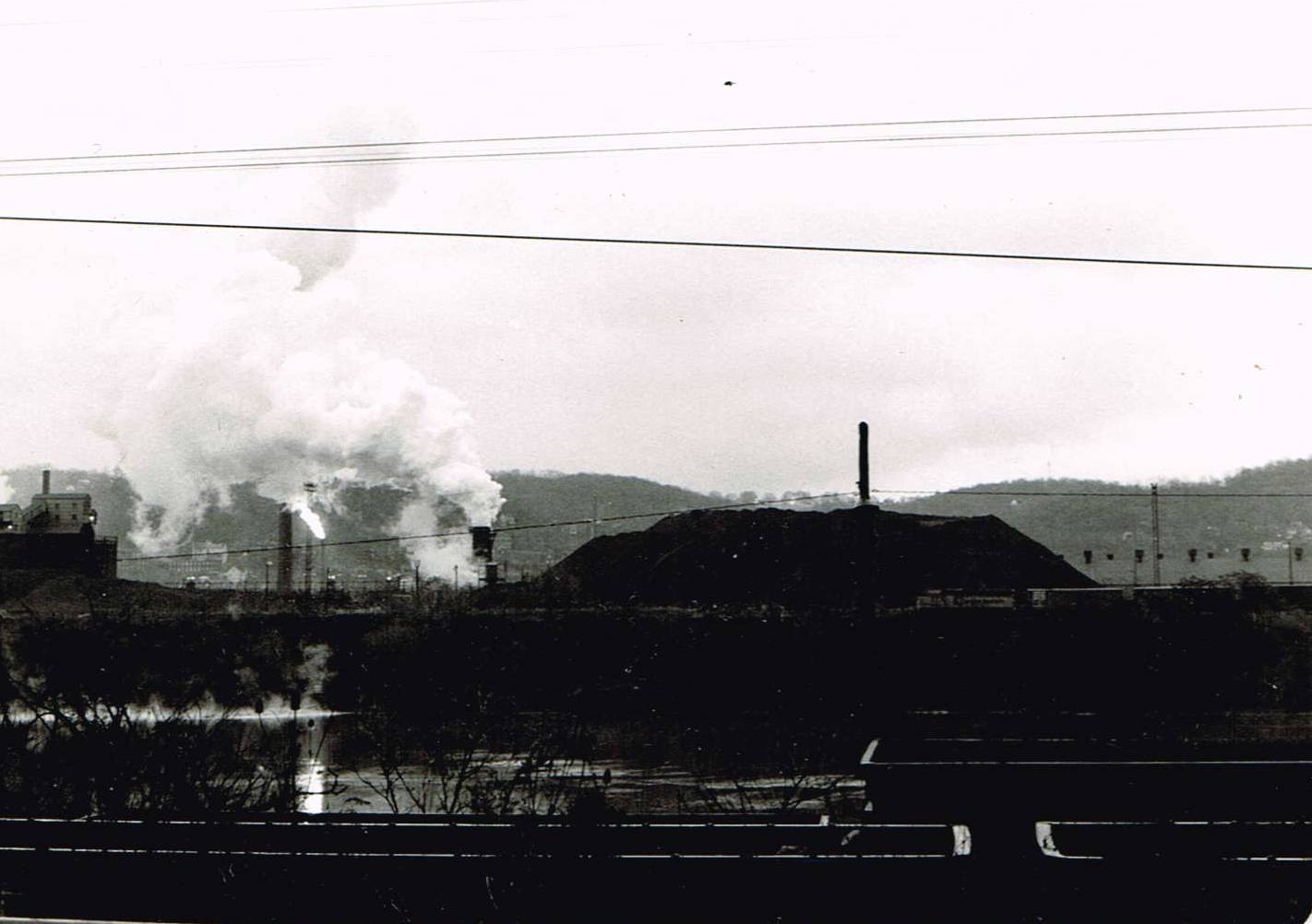
In 1980 when I was writing an opinion piece on preservation for the Minneapolis Star, I decided to take some photos of Braddock, the mill town across the Monongahela from Homestead. The idea was to have something for illustrator Craig Macintosh to use with the piece.

On a dreary winter day during a visit, I put black/white film in my Nikon and went over to Braddock. I started at the bottom of the hill and wound my way to the cemetery at the top. Here are the photos I took, roughly in chronological order. They show a town that has pretty much lost hope. In that year the U.S. Census counted 5,634 inhabitants, down 35.9% from 1970, the biggest population drop in a decade in Braddock history.

Note: For those unfamiliar with the history of the area, Braddock was named after British General Edward Braddock. On July 9, 1755, British and British colonial troops under Braddock's command were ambushed and defeated by French and Indian forces in an engagement  near the present town. Three days later, Braddock died of wounds suffered during the battle. His body was allegedly buried on the banks of the Monongahela, and wanting to keep his grave secret, the British rode their horses and wagons over the site. This failed military expedition that attempted to wrest Fort Duquesne (later Fort Pitt) at the confluence of the Monongahela and Allegheny Rivers from French control, is known as "Braddock's Defeat."

Double houses
"Economic Crisis. . .Great Depression. . .Proletariat"
Burned out house.
Burned workers' houses.

Shuttered stores on Braddock Avenue
Political graffiti
An inhabited block
Old U.S. Post Office
By the mill
 Edgar Thompson Works
By the railroad tracks
Library Street at Parker Avenue
The Carnegie Free Library, the FIRST Carnegie Library, built 1888, a National Historic Landmark, then shuttered.
The Frank Vittor statue, "Winged Victory", a WWI memorial. It was this photo that Macintosh chose for his illustration.
A cemetery monument
It would be interesting to walk around Braddock today and try to find the places shown in these photos. Perhaps on my next visit to Pittsburgh, I will do just that.


Today, after decades of decline, thanks to Mayor John Fetterman, Braddock is looking better. Since 2005, Fetterman and the citizens of Braddock have worked tirelessly to attract new residents, especially those from the arts community. The mayor also initiated various rehabilitation efforts that have aided in Braddock's renewal. Fetterman is currently a candidate for U.S. Senate in Pennsylvania. https://johnfetterman.com/

Braddock was in defeat, but now, three decades later, is finally getting on its feet and standing proud.

Sunday, December 20, 2015

Forever Green: Trees of the Winter Solstice


Snowy evergreen trees in Austria
Many people are familiar with the old German folk song that goes like this (literal translation at right):
 O Tannenbaum, o Tannenbaum,                               O fir tree, O fir tree,
wie treu sind deine Blätter!                                          how true (loyal) are your needles!
Du grünst nicht nur                                                    You're green not only
  zur Sommerzeit,                                                          in summertime,
Nein auch im Winter, wenn es schneit.                       But also in winter, when it snows.


The most important characteristic is that the tree is green year-round, even when it's snowing. The symbolic use of evergreen trees and plants around the winter solstice is a European tradition going back to antiquity. Ancient peoples associated evergreens with the promise of returning life. As the shortest day of the year in the northern hemisphere approached, people decorated their homes and temples with evergreens to celebrate the daylight lengthening again. In northern Europe, the Celts and Scandinavians marked the winter solstice by decorating with evergreens. On Jul, December 20th, the darkest time for all living things, ancient Norsemen celebrated the rebirth of sun god Baldr, slain with a sprig of mistletoe.
"The Death of Baldr" by W.G. Collingwood (1908) illustrates how Loki guided the hand of the blind Höðr in throwing the fatal branch of mistletoe.
Our modern Christmas tree--a tree decorated to celebrate Christmas--was documented first in 16th century Germany when Christians began cutting spruces, pines, and firs to bring into their homes. But in the English-speaking world many Christians associated the trees with pagan religions even into the mid-19th century. In 1659 the "no fun" New England Puritans banned not only Christmas trees, but any celebration of Christmas that was not a religious service. However, the practice of using an evergreen as a Christmas tree finally caught on in anglophone countries when Queen Victoria and her German husband were drawn standing around a decorated tree with their children in 1848. If the Queen could do it, so could her subjects.
The famous picture of the royal family gathered around their Christmas tree.
Three years later, an entrepreneur opened the first American Christmas tree market in New York City, selling trees he cut down in the Adirondack Mountains. Fifty years after that (1901), the first commercial Christmas tree farm was established in New Jersey with the planting of 25,000 Norway spruce. Since then, the growing and selling of holiday trees has become a billion-dollar industry.
A wagon loaded with trees in Hartford, Connecticut, c.1890 (Connecticut Historical Society)

By the 1890s, the decorating of Christmas trees had become a well established tradition in America. Two scenes in Darkness Visible are devoted to describing the Bernhardt and Jones families' setting up and decorating their Christmas trees. In East Liberty, Karl Bernhardt drills holes in a broomstick and places sticks in them to create a rustic artificial tree; his wife and daughter decorate it with cookies and candy. Emlyn buys a fir from a German farmer and winds up helping arrange some around the altar in St.John's Lutheran Church. Later, he watches Eirwen hang home-made decorations on it.

Both of these scenes in Darkness Visible are taken from personal experience and family folklore; both are stories from the German tradition of the winter evergreen tree. One of my father's favorite Christmas stories was how his German immigrant grandparents were so poor that on Christmas Eve his grandfather would make a tree out of a broomstick, on which they hung edibles.  The other half of the story is the part where their seven sons would come downstairs before dawn's early light and strip the tree bare in minutes. The wooden structure Emlyn visited was long gone by the time my family went to St. John's Lutheran, but in the brick 20th century church on 10th and Ann, the congregation would set up a creche to the left of the altar and place undecorated evergreen trees around it.
The Metropolitan Museum in New York City annually displays a Baroque creche with an exquisitely adorned tree.
Until the late 19th century, there were no electric tree lights, so people used candles--a practice, according to folklore, initiated by Martin Luther.  My Grandfather Busch was so terrified of fire after his sister died when her skirts caught fire from a fireplace that he would allow the candles to burn on the tree only a few minutes before extinguishing them. While they burned, he stood anxiously by with buckets of water and sand, just in case. My father and his sisters had to be satisfied with the brief display--although it was made more special by its brevity.

The first electrically lighted White House Christmas tree, standing in the Oval Office, 1895.
My family has always been partial to the short-needled evergreens, the spruces and firs, because, as my mother said, they "smell like Christmas." Selecting and decorating a tree has always been an important part of holiday preparations. One year I remember freezing for over an hour in the Second Ward schoolyard on Eighth Avenue while my mother and I looked through just about every tree in the lot in our quest for the "perfect" one. I'm sure we found it. We always did.
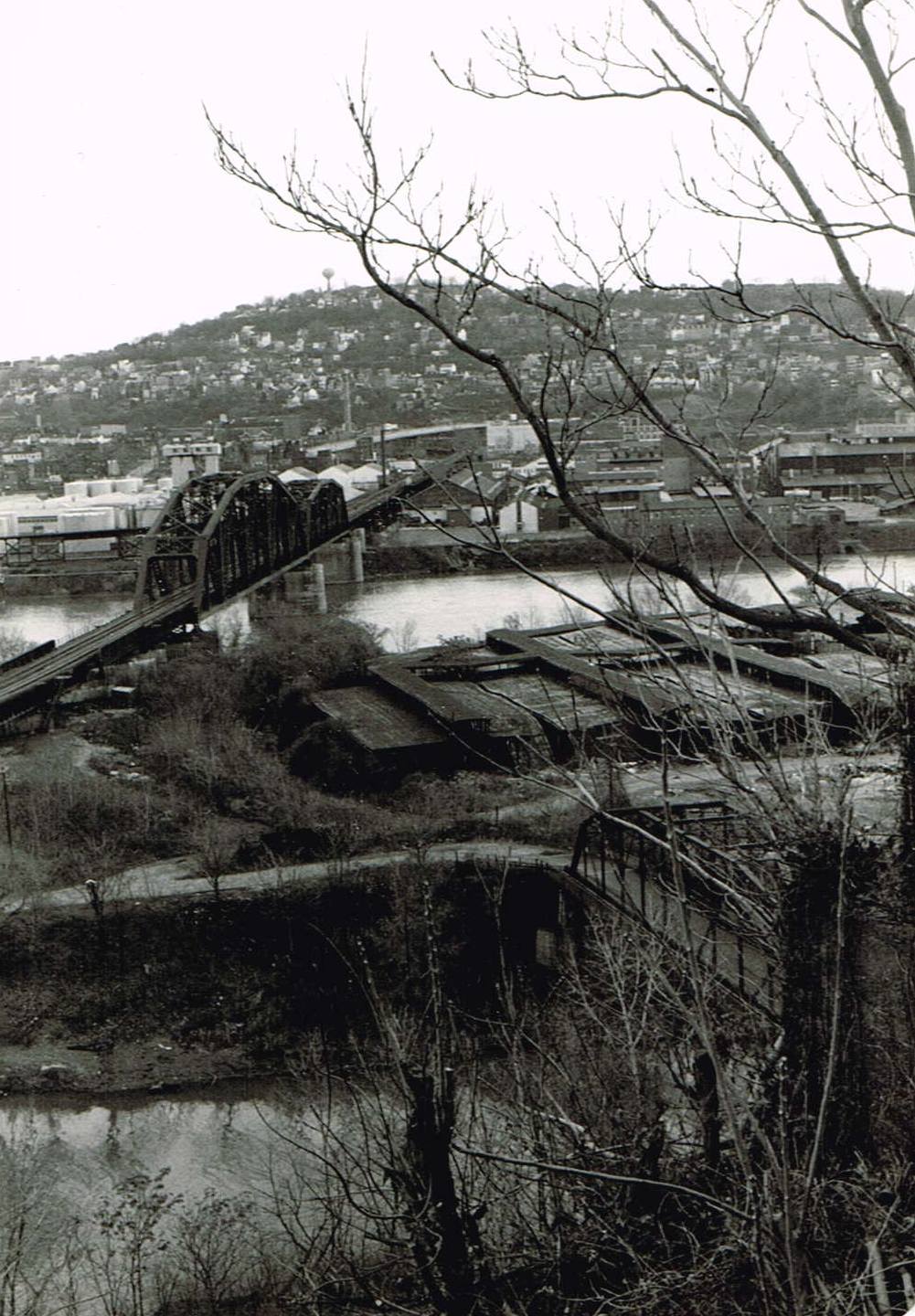
Christmas morning, showing off the doll I got from Santa, with the tree and train.
Several years ago, during an especially snowy December in Minneapolis, I decided to indulge my fantasy of bringing home a tree on a sled. I hauled out my Flexible Flyer, polished the runners, hitched up my two border collies and headed for the neighborhood hardware store three blocks away.

I picked out the usual perfect tree, tied it to the sled, and started home. All went well for the first half block, but then the 8-foot tree started to slide off the 5-foot sled. The dogs, nervous about the big scary weird thing on the sled, pulled hither and yon, making things worse. Three times during the trip home, the tree fell off the sled. Getting up and down curbs at street corners was tricky. By the time I got the tree home, I was exhausted and the tree and dogs were covered with slush. The next day, after we all thawed out, I decorated the tree and determined that it would be the first and only one I'd venture to haul home on a sled.
If you want to haul a tree on a sled, use huskies, not border collies.
This year I downsized my tree to about half the size of ones in recent years. I got another Fraser fir--bought it trussed up at the local hardware store lot--and when I untied it and set it up, voila! it was (once again) perfect. I decided that I'd decorate it only with old ornaments from my childhood in Pittsburgh. In the 1950s, my cocker spaniel Buffy knocked the tree over twice chasing the toy train underneath. We lost most of my father's childhood ornaments in these mishaps. Over the years, they all were broken except one, a Liberty Bell c. 1910.  I still have the Bell, which enjoys pride of place on my tree every year. This year it hangs on the tree with a few dozen glass balls with stripes, stars, and silhouettes of wise men on camels from the 'Fifties. As in the 'Fifties, the lights are electric, not wax candles.
The old Liberty Bell ornament (center) with a drum I made out of milk caps in first grade.
The winter solstice holidays, whether they be Christian, Jewish, pagan, or of recent invention, are associated with many traditional practices. One of the loveliest, one that resonates with the symbolism of the solstice, is the decorating of evergreen trees. In many homes, the Christmas tree is the decorative focal point of the holiday. Whether it's a huge Norway spruce or a tiny Norfolk pine or one made of plastic or aluminum, the Christmas tree embodies the meaning of the season--rebirth, light and life overpowering darkness and death.
1960's Modern Christmas tree by Lawrence "Bud" Stoecker
Postmodern "ABIES Electronicus" on Grand Square, Brussels, Belgium
This year's perfect Fraser fir, adorned with 'Fifties glass ornaments and handmade ones.

 Happy Solstice    
                          Jolly Yule                                    
                                            Merry Christmas

Saturday, October 31, 2015

Twice-Told Tales II: Steel Town Ghosts

In last year's Halloween post I re-told my father's story about spooky goings-on in the Woodlawn School auditorium. This year I have several more tales of ghosts and apparitions from Pittsburgh.
Spooky stairwell in the east wing of the Homestead Library.--Photo by Ceridwen Christensen

The haunted theater is a common tale. In addition to the Woodlawn auditorium, the Music Hall of the Carnegie Library of Homestead--not to mention the library itself--is alleged to be haunted. However, these stories have been told so often by so many people that it's impossible to know the origins. Some people believe that these are the ghosts of steelworkers taking revenge on Carnegie for the '92 Strike. I don't buy it. By the time the library was built, the unionists had scattered and the mill was filled with replacement workers. I have never heard a first- or second-person account about Homestead Library ghosts, nor experienced anything there myself. If you want to hear the traditional ghostlore of the place, I'd suggest going on one of the ghost tours that are offered as fundraisers for this historic building.
The Pittsburgh Playhouse, built 1933,

Another theater haunting story is another one of my father's. Dad was active in Pittsburgh theater beginning with his college days at the University of Pittsburgh. At the Pittsburgh Playhouse in the 1930s, Dad worked with an actor named John Johns. One evening in 1963 Johns suffered an apparent heart attack after dinner in the Playhouse restaurant.  My father's version was that Johns walked to his dressing room, #7, but died on its threshold; another version is that Johns' colleagues carried him to #7, but he died before they could get him inside. Either way, since then, many witnesses have heard Johns' footsteps coming up to the door of #7--and ceasing.
The crumbling portico of the stone house that once was home to the Eagles lodge in McKeesport.--Photo by Jonathon Denson
 Real estate agents are often good sources of uncanny tales. I've heard two stories from realtors about houses in McKeesport. Having fallen on hard times, McKeesport can be a spooky place, especially at night, so it's easy to imagine ghosts roaming the halls of the old, abandoned buildings there. But both of these tales date back from my early years of ghost story collecting, so who knows if these houses are even standing.
A rickety vacant frame house in McKeesport.--Photo by Jonathon Denson
 Story #1 involves a rarity among my story collection: physical contact. An agent was showing prospective buyers a turn-of-the-century house. As she entered the house, the agent immediately felt a hostile presence. As she took the couple through the downstairs rooms, the agent felt shadowed by a malevolent energy.  This feeling stayed with her on their tour of the upper floors. As the agent stood at the top of the staircase in preparation for leaving the house, she felt unseen hands forcefully push her from behind. The couple behind her were astonished to see the realtor suddenly plunge forward. Caught unaware, the agent desperately grasped at the banister, managing to stop her fall a few steps down. Badly shaken, the agent and buyers beat a hasty retreat. Needless to say, the couple did not make an offer on the property.
A once-grand McKeesport Victorian, now abandoned.--Photo by Jonathon Denson

Story #2 also involves physical movement. A large Victorian house that had stood vacant for many months went on the market. The only furnishing remaining in the house was a grand piano in the parlor. The first time the listing agent brought clients to the house, he could not get the front door open. The huge oak door would unlock, but would not budge from its closed position. The agent went around back and came in through the kitchen. When he went into the front rooms, he couldn't believe his eyes: the grand piano was firmly lodged against the front door. He assumed that mischievous kids had shoved the piano to bar entrance, but there was no evidence of a break-in. A week later, the same thing happened to another agent. She had tried to bring clients through the front, only to find the piano blocking the way. Once again, the listing agent enlisted friends to help him move the heavy piano back to the parlor. However, when the piano was moved in front of the door on three more occasions during the ensuing weeks, the agent came to believe that something supernatural was at work. Was the house haunted, or was the piano? In any case, the agent urged the sellers to remove the piano, which they did. The piano stayed put in its new home, and the house eventually sold. The agent hadn't heard stories from the new owners--and frankly, did not want to know if large objects were moving about inside the house.
A typical Munhall brick foursquare house.

The last story is about a modest foursquare house in Munhall.  In the 1980s, a family of four moved into the house. The nine-year-old son, "Tom", got one of the back bedrooms, while his older sister got the other. They had not been in the house long when the son (who told me this story) began waking in the middle of the night, feeling like someone was in the room watching him.  After this had happened frequently over a period of several months, the boy asked his parents if he could change rooms. When he told them why, his father scoffed at him, telling him that he had an overactive imagination. However, his sister believed him, and sometimes he would pick up his pillow and blanket and go into her room to sleep on the floor. Then, one day, Tom saw the ghost. He awoke at dawn, disturbed by something. There, in the half-dark, standing by the door was the misty form of a middle-aged man in work overalls, glaring at him. The boy stared at the apparition, terrified, for a moment. And then it vanished. When he told his parents about the apparition, his father again chided him, saying that ghosts don't exist. But fortunately, his father didn't prohibit Tom from sleeping in the sister's room whenever he felt the presence in his own. The family lived in that house for two years, and every day of their stay there the boy was anxious about spending time in his room. Now an adult, Tom thinks that the ghost was that of a former owner, a deceased steelworker, whose room became his--sort of. At any rate, Tom was happy to see the last of that place.

A street of abandoned houses in McKeesport. If they aren't haunted, they should be.--Photo by Jonathon Denson
From ghoulies and ghosties and long-leggity beasties, and things that go bump in the night, Good Lord deliver us. . .and Happy Hallowe'en to all!